Karma, Selfish Mining, and Team Rocket: The Research Behind Avalanche
From a 2003 resource-sharing paper to a 2018 anonymous consensus proposal, Emin Gün Sirer’s research crossed incentives, mining, and distributed agreement before Avalanche launched in 2020.
3-Minute Fast Briefing
- The ParadoxIn June 2003, Vivek Vishnumurthy, Sangeeth Chandrakumar, and Emin Gün Sirer presented Karma, an accounting framework for peer-to-peer resource sharing.
- The Turning PointIn November 2013, Ittay Eyal and Sirer showed how selfish mining could reward a mining pool disproportionately under their model.
- The LegacyTeam Rocket’s 2018 proposal and Cornell research fed into Avalanche, whose mainnet launched in September 2020.
Chronological Timeline
Vishnumurthy, Chandrakumar, and Sirer present a distributed accounting framework for peer-to-peer resources.
Eyal and Sirer analyze how strategic block withholding can produce disproportionate mining rewards.
An anonymous proposal circulates through IPFS, introducing a metastable consensus family.
Sirer, Kevin Sekniqi, and Ted Yin develop the research into a blockchain platform.
The launch announcement describes sub-second finality and customizable chains with their own validator sets.
1. Karma: Keeping Score Before Bitcoin
In June 2003, Vivek Vishnumurthy, Sangeeth Chandrakumar, and Emin Gün Sirer presented Karma at a workshop on the economics of peer-to-peer systems. This was five years before Bitcoin’s 2008 white paper. The paper asked how a network could reward those who supplied resources when others preferred only to consume them.[1][4]
Karma kept balances that rose when participants contributed resources and fell when they consumed them. Groups of nodes called bank-sets maintained those accounts, with a distributed hash table organizing the system’s state. It was a concrete accounting design for resource sharing.[4]
The connection to later cryptocurrency research is a question of incentives: who contributes, who records the exchange, and what stops participants from exploiting the rules? Karma approached those questions by combining an economic mechanism with distributed organization.[4]
2. Selfish Mining: A Problem of Incentives
In November 2013, Ittay Eyal and Sirer published “Majority is not Enough: Bitcoin Mining is Vulnerable.” They examined a strategy in which a mining pool withholds blocks and releases them strategically, seeking a greater share of rewards than its share of computing power.[5]
Their model put the profitability threshold at one-third of mining power when competing honest miners did not favor the selfish pool’s branch, and at one-quarter when half did. These are the conditions behind the familiar figures of roughly 33% and 25%; they are not universal takeover thresholds.[5]
The paper also described an incentive for miners to join a successful selfish pool, creating a route toward concentration under its assumptions. This was a modeled vulnerability and a reason to examine protocol incentives, not a record that Bitcoin had already fallen under one pool’s control.[5]
3. Team Rocket and the Sampling Idea
In May 2018, a paper circulated through IPFS under the pseudonym Team Rocket: “Snowflake to Avalanche: A Novel Metastable Consensus Protocol Family for Cryptocurrencies.” Cornell’s account connects that proposal with work Sirer, Kevin Sekniqi, and Maofan “Ted” Yin were pursuing.[3][10]
The approach offered a different way to organize agreement. Rather than asking every validator to exchange every vote with every other validator, a node repeatedly samples a small subset. Think of people in a stadium checking the preferences of a few others, then asking again: repeated local observations can reinforce a common choice. The stadium is an illustration, not a performance measurement.[6]
In the documentation’s example, a node samples 20 validators. Acceptance depends on configured voting and confidence thresholds. Security is probabilistic within the protocol’s assumptions: parameters can make conflicting decisions by honest validators extremely unlikely. This does not establish infinite capacity, zero failure probability, or a fixed completion time for every network condition.[6]
4. From Research to a Network
Sirer, Kevin Sekniqi, and Ted Yin formed Ava Labs to develop the platform. Cornell’s August 2020 report describes how the anonymous proposal and the team’s related research came together in the work of building operational software.[3][12]
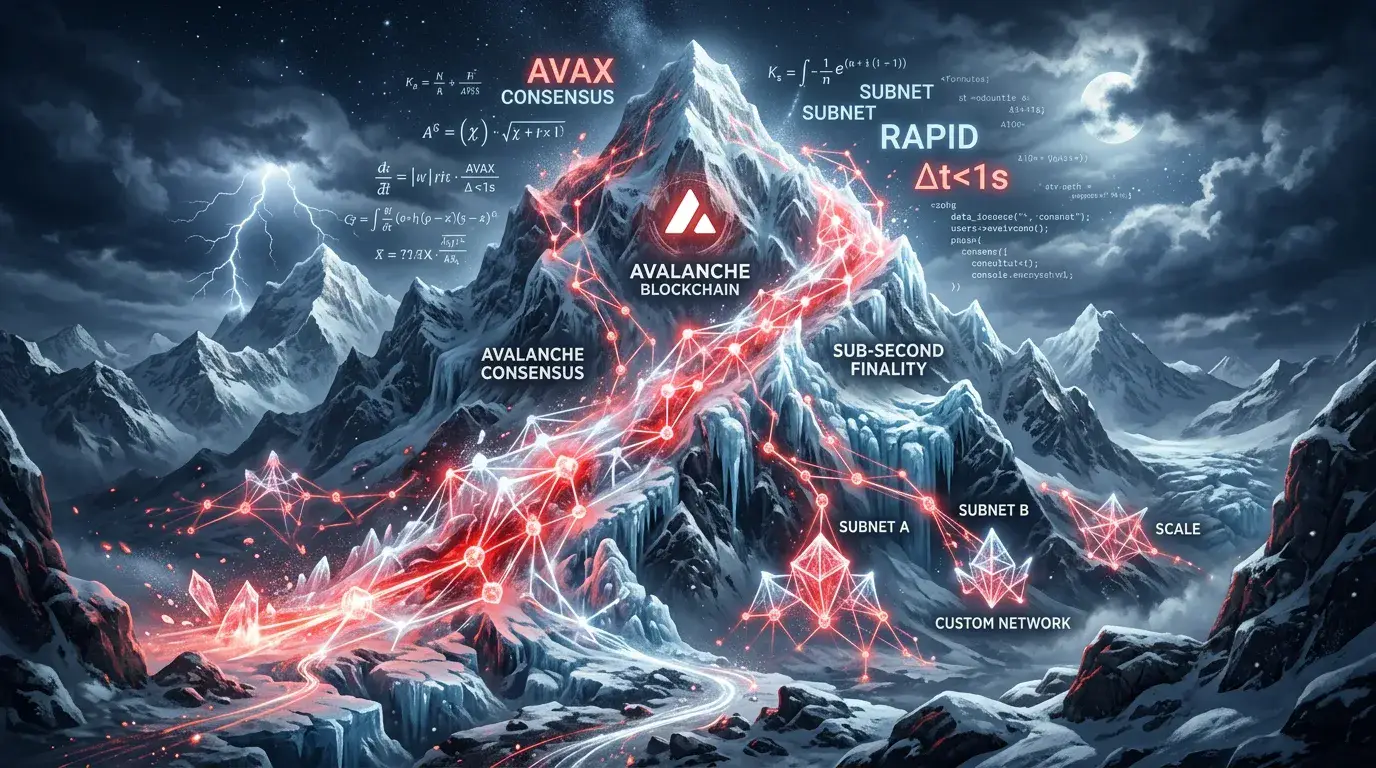
Avalanche’s mainnet launched in September 2020. Its X-Chain, P-Chain, and EVM-compatible C-Chain divided asset exchange, platform coordination, and smart-contract execution. The launch announcement advertised transaction finality in less than one second. That is a source-attributed performance claim measured in seconds, not sub-millisecond finality or an unconditional guarantee.[7][6][11]
Custom Subnets offered chains their own validator sets and virtual machines. Historically, their validators also had to validate the Primary Network, but that overlap did not make the entire Primary Network responsible for each Subnet’s security. ACP-77 states that Subnets supply their own security and data availability. With Etna, Avalanche L1 validators can operate without validating the Primary Network.[7][8][9]
5. What the Research Leaves Us
Karma in 2003, selfish-mining research in 2013, Team Rocket’s paper in 2018, and a live network in 2020 form a documented sequence. The work moved between resource accounting, economic incentives, and the mechanics of agreement. These are related problems, even though they are not the same invention.[1][5][3][7]
Avalanche’s origin is more useful when those distinctions remain visible. A compelling consensus idea still needs implementation, explicit security assumptions, and validators willing to operate it.[6][8]
Research can open a path to a network; it does not settle every question about that network’s future.[3][7]
Key Takeaways for Investors & Builders
Repeated sampling, explicit assumptions
Small repeated polls can coordinate a large network. Safety still depends on parameters, validator behavior, and the protocol’s assumptions.
A paper needs an implementation
Ava Labs turned research into an operating platform. Technical promise and sustained adoption remain separate questions.
Critique is part of construction
The selfish-mining paper shows why a system’s economic incentives deserve scrutiny alongside its cryptography.
Continue reading
Explore the topic through other cases and contexts.



Sources & References
- [1]Source 1: Cornell: Emin Gün Sirer’s research bibliographyCornell University Department of Computer Science · 2020-09-21
- [2]Source 2: Avalanche platform history and consensusWikimedia Foundation · 2024-02-15
- [3]Source 3: Cornell Chronicle: Avalanche’s first public token saleCornell Chronicle · 2020-08-04
- [4]Source 4: Karma: The original resource-sharing paperCornell University
- [5]Source 5: Selfish mining: Eyal and Sirer’s original analysisIttay Eyal and Emin Gün Sirer / arXiv
- [6]Source 6: Avalanche: Repeated sampling and probabilistic safetyAvalanche Builder Hub
- [7]Source 7: Avalanche: Mainnet launch announcementAvalanche
- [8]Source 8: ACP-77: Subnet and L1 security boundariesAvalanche Builder Hub
- [9]Source 9: Etna: Sovereign Avalanche L1 networksAvalanche Builder Hub
- [10]Source 10: Cornell dissertation: Team Rocket paper bibliographyCornell University
- [11]Source 11: Avalanche: Roles of the X-, P-, and C-ChainsAvalanche Builder Hub
- [12]Source 12: AWS: Ava Labs founding and Avalanche developmentAWS Startups