The Crowd That Raised More Than $47M but Could Not Buy the Constitution
More than 17,000 people assembled roughly $47 million in ETH within a week and became the direct underbidder for a first printing of the U.S. Constitution. The $43.2 million sale exposed the gap between a visible crypto treasury and the money a bidder could actually spend after premiums, taxes, custody and insurance. ConstitutionDAO then chose refunds over a new mission; gas reduced smaller recoveries, while PEOPLE survived as a traded token and a symbol adopted by another community.
Key Points
- Reuters reported 17,437 contributors and more than $47 million, about 11,600 ETH, and distinguished the $41 million winning bid from the $43.2 million final price including overheads. Sotheby’s separately reported the $43.2 million sale result.
- The treasury was visible and the DAO had publicly committed to a $41 million bid ceiling, but no reviewed source proves Kenneth Griffin inspected the wallet or chose his bid because of it.
- ConstitutionDAO closed and offered ETH refunds at the original 1 ETH per 1,000,000 PEOPLE ratio, less gas; PeopleDAO later adopted PEOPLE for a separate community.
Chronological Timeline
With days left, the development record abandons custom fundraising contracts and fixes one million PEOPLE per ETH with no cap.
After nearly eight minutes of bidding, Sotheby’s sells the printing for $43.2 million to the client later identified as Kenneth Griffin.
The official page offers contributors a choice between claiming PEOPLE and burning it for ETH at the original ratio, while paying gas.
After several days of debate, ConstitutionDAO says it lacks the capacity to build a different ongoing organization and winds down.
PeopleDAO forms after the dissolution and uses the token for its own proposals and contributor rewards.
1. Eight friends found an object before they had an organization
The project began with an unusually concrete deadline: Sotheby’s would sell a first printing of the final text of the U.S. Constitution on November 18, 2021. Graham Novak and Austin Cain helped open the first Discord conversation; within days, the idea had expanded far beyond its small starting group. The lot was one of the rare surviving copies from the Constitutional Convention printing, so there was no interchangeable asset the group could buy later if it missed this auction. That scarcity made the calendar, rather than a software roadmap, the project’s first governing constraint.[8]
The organizers needed to collect ETH, turn it into a legally usable bid and plan custody for a fragile document. They did not have time to invent and audit every contract. On November 13, the development record says the team stopped custom crowdfund work and chose Juicebox. The choice traded bespoke control for something deployable before the sale. It also fixed the later refund mechanics before anyone knew whether the bid would win.[2]
We cannot make our own super secure solidity contracts in 5 days.[2]— ConstitutionDAO development FAQ, November 2021
Juicebox accepted ETH and accounted for one million PEOPLE per ETH, with no fundraising cap. PEOPLE was meant to support decisions if the bid succeeded; it was never a fractional legal title to the paper itself.[2][8]
2. Seventeen thousand contributors became one bidder
By auction night, Reuters reported 17,437 contributors and more than $47 million, about 11,600 ETH. Sotheby’s used the broader wording ‘more than 17,000’ and ‘more than $40 million.’ The dollar valuation moved with ETH and the counting moment, so the sources are measurements rather than one immutable treasury number. The exact figures therefore belong with their reporting dates: they describe a fundraiser whose crypto balance and dollar headline could change between publication and the auction.[3][4][5][10]
The achievement was organizational speed. People who had never met created a treasury large enough to become the direct underbidder for a document expected to sell for $15–20 million. Yet the onchain balance was not the amount that could be placed as a hammer bid.[3][6]
Galaxy explained that the bidder also needed room for the buyer’s premium, taxes, insurance, storage and transport. Sotheby’s later said the DAO publicly committed to a $41 million ceiling. The treasury and ceiling reduced secrecy, but the reviewed record does not show Griffin consulting the wallet or explain his private bidding motive. In other words, transparency helped contributors verify the treasury while simultaneously revealing the bidder’s financial boundary. No contemporaneous source reviewed here records Griffin monitoring the address.[5][6]
3. Eight minutes separated collective money from the object
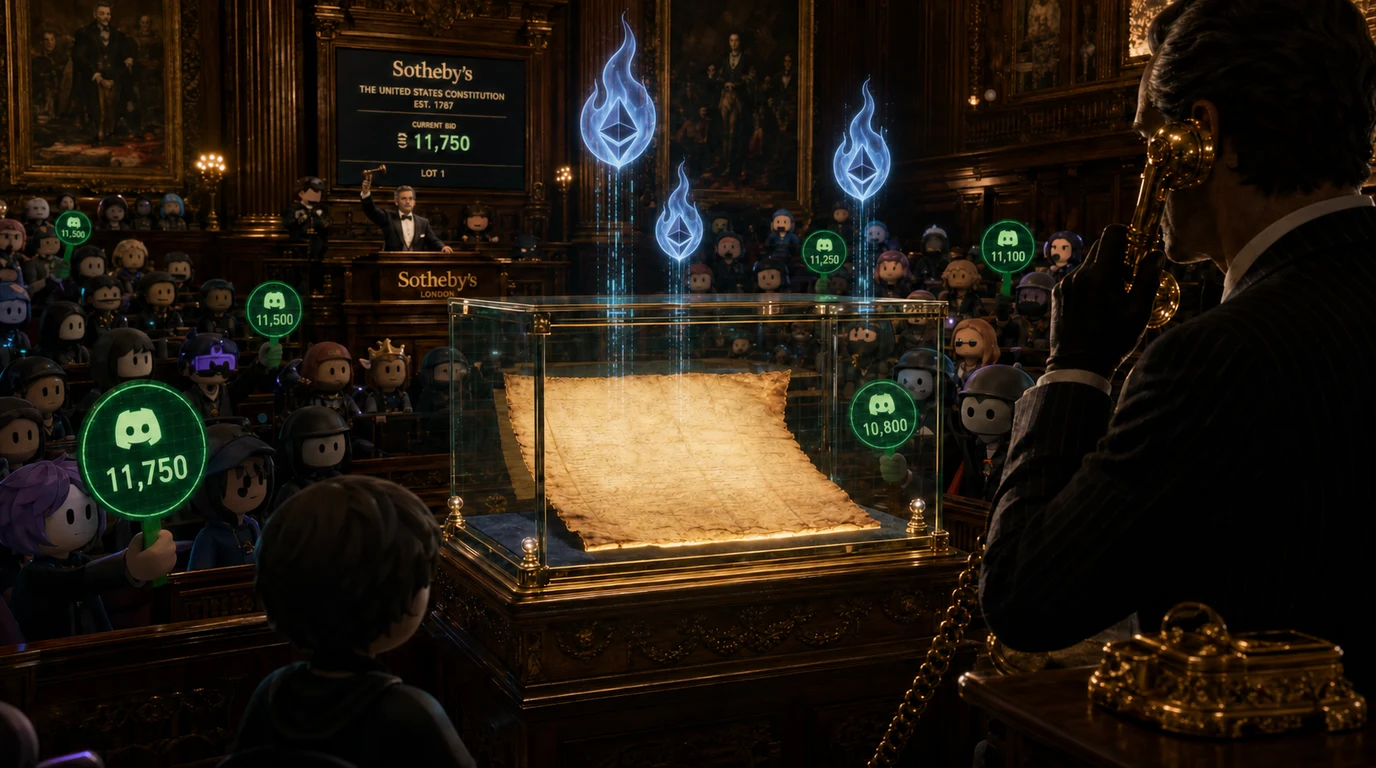
On November 18, two bidders contested the lot for nearly eight minutes. Reuters reported a $41 million winning bid and a $43.2 million final price including overheads; Sotheby’s named ConstitutionDAO as the direct underbidder and called $43.2 million the sale result. The distinction matters because the DAO had to budget beyond the hammer price. A crowd could appear richer than the final buyer and still have less room for the next bid once transaction costs around the physical object were reserved.[3][10]
Kenneth Griffin was bidding anonymously through Sotheby’s chair Brooke Lampley. His identity became public after the sale; Sotheby’s later confirmed that he acquired the printing and loaned it to Crystal Bridges Museum of American Art.[4]
Sotheby’s Magazine later said the DAO had publicly committed to a $41 million ceiling and inferred that Griffin knew what it would take to beat the group. The first point is a disclosed constraint; the second is the magazine’s retrospective causal interpretation. The reviewed record does not show Griffin consulting the wallet or explain his private bidding motive.[5]
4. Returning the treasury meant asking everyone to transact again
Defeat removed the single purpose around which the crowd had organized. Some members wanted another purchase or a new public mission, but the core team concluded it could not properly maintain an ongoing project. The official page records the decision to wind down. That was a governance decision made after the loss, rather than a failure encoded automatically by the token. The organizers had gathered money for one named object and declined to convert that narrow permission into an open-ended mandate.[1][6]
We now believe this project has run its course.[1]— ConstitutionDAO wind-down notice
Contributors could claim PEOPLE or burn claimed or unclaimed PEOPLE for ETH at one ETH per one million tokens, the original contribution ratio. The refund was proportional, but not costless: the user still paid Ethereum gas. The contract could calculate each share, but it could not make Ethereum block space free or combine thousands of individual choices into one collective withdrawal.[1][2]
Axios reported observer estimates around $50 per transaction, a meaningful charge beside a median contribution a little over $200. It also cited an estimate of nearly $1 million in gas already spent by participants at that point. These were dated estimates, not a final refund accounting or a uniform fee charged to every contributor.[7]
5. PEOPLE kept moving after its issuer stopped proposing a future
The final ConstitutionDAO notice says PEOPLE has no rights, governance or utility in the closed project beyond the stated redemption route. It also lets holders keep the token while refusing to endorse whatever later projects might do with it.[1]
That opening produced a separate afterlife. PeopleDAO says a new group adopted PEOPLE for its own voting and contributor rewards after ConstitutionDAO dissolved. This was a new community choice, not continuity of the old auction mandate. Its own rules and rewards should therefore be attributed to PeopleDAO, not retroactively presented as promises made to the original auction contributors.[9]
The episode therefore ended with two different records. Sotheby’s kept the $43.2 million sale and the buyer who acquired the Constitution. Ethereum kept a transferable receipt whose market price could detach from the original refund ratio.[1][3]
What ConstitutionDAO proved was narrower and more durable than the old heroic slogans: an internet crowd could assemble a world-record underbidder in a week, but a public treasury, a physical auction and thousands of individual refunds still belonged to different systems.[3][6][7]
Key Takeaways for Investors & Builders
A public treasury was not the same as a spendable bid
The crowd could show tens of millions on Ethereum, yet premiums, tax, custody and insurance reduced the amount available at the rostrum.
A refund promise still had a network toll
Juicebox made proportional ETH recovery possible, but each participant had to submit a transaction; roughly $50 gas estimates mattered far more to a median contribution just above $200.
Closing an organization did not close its symbol
ConstitutionDAO rejected a new mission, while holders and a later PeopleDAO kept PEOPLE alive for uses the original core team did not endorse.
Continue reading
Explore the topic through other cases and contexts.


Sources & References
- [1]Source 1: ConstitutionDAO wind-down and refund pageConstitutionDAO · 2021-11-23
- [2]Source 2: ConstitutionDAO development record and Juicebox FAQConstitutionDAO · 2021-11-13
- [3]Source 3: Sotheby’s November 18 auction resultSotheby’s · 2021-11-18
- [4]Source 4: Sotheby’s retrospective identifying the buyerSotheby’s · 2022-11-01
- [5]Source 5: Sotheby’s 2022 account of the disclosed bid ceilingSotheby’s
- [6]Source 6: Galaxy Research: Power to the PEOPLEGalaxy Research · 2021-11-23
- [7]Source 7: Axios report on refund gas costsAxios · 2021-11-22
- [8]Source 8: TechCrunch report from auction nightTechCrunch · 2021-11-18
- [9]Source 9: PeopleDAO account of adopting PEOPLEPeopleDAO
- [10]Source 10: Reuters report on the auction and contributor totalReuters via Investing.com · 2021-11-19