GRVT’s 4× Airdrop: Four Times What?
A larger multiplier did not create more GRVT. It changed the weight of deferred claims on a fixed pool—and the final release schedule made the result more complicated than “take a quarter now or four times later.”
Key Points
- GRVT fixed its community airdrop pool at 280 million tokens. Multipliers changed participants’ shares of that pool, not its size.
- The official 4× example increases total allocation shares by 2.4×: only tranches moved to a later date receive the corresponding multiplier.
- Allocation, unlock, claim and withdrawal are separate steps. Off-chain matching and ZK settlement do not turn an unvested allocation into spendable tokens.
Chronological Timeline
GRVT announces that Season 2’s share rises from 12% to 18%; The Block reports a June 30 points deadline and 28% combined community allocation.
The official selection window runs from July 10 at 06:00 UTC to July 17 at 00:00 UTC, with optional four- or eight-month deferral.
The TGE article sets out individualized tranches, a fixed pool and the conversion from weighted shares to tokens.
The official launch notice specifies 13:00 UTC. Later tranches remain subject to their release dates and claim windows.
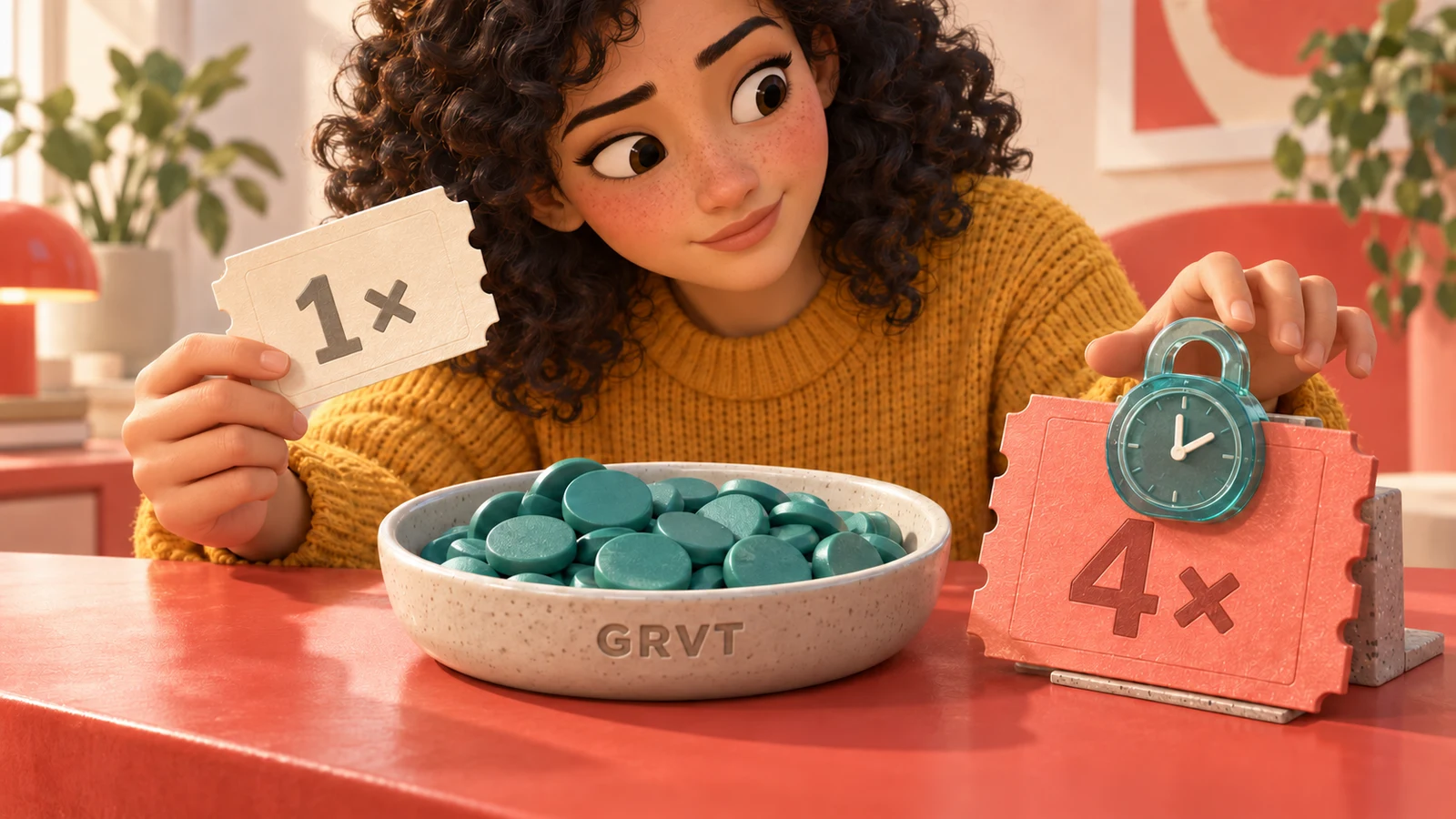
The number on the ticket
A ticket marked 4× is only useful once you know what is being multiplied. Before GRVT’s July 30, 2026 token launch, eligible airdrop recipients could elect to wait four or eight months for a larger allocation weight. The selection window closed on July 17. The question was about both a share of the rewards and the date it could become usable. It was not a guaranteed fourfold return.[1][2]
The registration guide described a standard allocation at TGE, the token generation event, for people who did not opt into the multiplier. But the more detailed July 28 launch article described releases in tranches over 12 months, with proportions differing by account activity. Reading the earlier shorthand as a promise to receive every token immediately—or as a universal choice between one quarter now and four times later—misses that second layer.[1][2]
Points became a claim on a finite pool
Season 2 awarded points for activity including trading, deposits and referrals. Those points were a way to divide rewards; they were not GRVT tokens sitting in a wallet. In March, GRVT increased Season 2’s allocation from 12% to 18% of supply. The Block reported that points could be accumulated until June 30 and that the combined community allocation had risen to 28%. The final launch explanation put the airdrop pool at 280 million GRVT.[5][7][11][2]
The launch calculation used 100 million pre-multiplier shares for Season 1 and 180 million for Season 2. After participants’ choices, GRVT reported 444.7 million weighted shares in total. Dividing 280 million tokens by 444.7 million shares gives approximately 0.6296 GRVT per share. A share here is a distribution unit, not company equity. A bigger personal numerator competes against a denominator affected by everyone else’s choices. The pool does not grow with the multiplier.[2][1]
Why the official 4× example ends at 2.4×
GRVT’s worked example starts with 33,000 allocation shares: 13,200 scheduled for TGE and 6,600 each for months 4, 8 and 12. That is a 40%–20%–20%–20% schedule. It is an example, not a schedule promised to every account. Without optional deferral, the illustrated total is 33,000 shares, converted to about 20,777 GRVT across the four releases.[3][2]
Choosing month 8 moves the TGE tranche eight months forward: 13,200 × 4 = 52,800 shares. The month-4 tranche moves only four months forward: 6,600 × 2 = 13,200. The original month-8 tranche stays at 6,600, and month 12 keeps its 6,600. The sum is 79,200 shares, or 2.4 times 33,000—not four times the whole allocation. At the published conversion rate, the chart shows about 49,864 GRVT. These are rounded illustrative totals, not a personal entitlement or a return forecast.[3]
That example also explains why “take one quarter now” is unreliable. Even without opting to defer, only the initial tranche was scheduled for launch; the rest already had later dates. In the 4× plan, the multiplier depends on how far each eligible tranche moves. To understand a recipient’s result, you need the starting schedule, the chosen deferral and the final tokens-per-share conversion. The plan label alone cannot supply those three values.[2][3]
A cap is different from circulating supply
The Ethereum token contract linked by KuCoin mints 1 billion GRVT to its initial recipient at deployment and exposes no subsequent mint function. Its verified source also includes burning, so outstanding supply can fall. The useful distinction is a hard upper cap, not a claim that exactly 1 billion tokens must always exist or be tradable. The 280 million community pool is one part of that cap.[13][9][2]
GRVT described phased distribution as a way to support a healthier launch and reward continued use. That is the project’s stated rationale, not evidence that the schedule prevents selling. GRVT’s published community release table assigns 74,312,328 tokens to TGE, with additional releases at months 1, 4, 8 and 12. That first entry is about 26.54% of the community pool, calculated from the table. The table’s rows add up to 116 fewer tokens than its stated total; these are the project’s published schedule figures. The first entry is neither a universal personal percentage nor the circulating supply of the entire token. Other allocation categories exist, and a release schedule alone does not establish how much was actually claimed, transferred or offered for sale. Deferral moves possible availability through time; it does not establish a future market price.[4][6][2]
Two clocks inside a hybrid exchange
GRVT’s litepaper describes an exchange with off-chain order matching and a custom ZKsync Stack Layer 2 whose validity proofs settle on Ethereum. Matching pairs buyers and sellers; settlement records the resulting state under the system’s rules. The document says individual order and position data are not broadcast publicly, while records remain accessible for compliance. This is the project’s architectural description, not an independent security audit.[6]
The airdrop’s calendar governs a different question: when a recipient may obtain an allocated token. A fast match cannot unlock a future tranche, and a validity proof does not certify the fairness of a rewards formula. The same litepaper defines GRVT as a membership and utility token, without equity or a right to revenue, profit or distributions. Waiting for more allocation weight should not be confused with receiving interest from the exchange’s earnings.[6][2]
Released, claimed, and finally movable
The launch notice distinguishes an automatically delivered first eligible tranche for users registered by July 17 from manual claims for later registrants and subsequent tranches. It gives each release a 30-day claim window. Unlocking and receiving are therefore separate events. GRVT’s withdrawal guide describes another step: tokens leaving the exchange exit to Ethereum, with a separate bridge for movement between Ethereum and BSC. An exchange balance and tokens already delivered to an external wallet are not the same state.[2][8][12]
Trading access had its own timetable. KuCoin’s notice scheduled GRVT/USDT spot trading for July 30 at 14:00 UTC. Bybit’s notice, labeled for selected regions, gave the same spot opening time. Coinbase Markets later confirmed GRVT-USD in full trading on Coinbase Exchange and Advanced. Those announcements establish market access; they do not override any individual’s vesting or claim conditions.[9][10][14]
The documentation itself needs care: the registration guide and launch article list an August 6 registration deadline, while the receiving guide still lists July 27. This account of the launch does not resolve that conflict into current claim advice. GRVT directs users to their Reward Portal for their own allocation and schedule. What the mechanism does establish is narrower: a fixed reward pool was divided using weights, and higher weights could require longer waits. To understand the outcome, follow the shares into tokens and then follow each tranche to its release date.[1][2][8]
Continue reading
Explore the topic through other cases and contexts.