The $170,000 Digital Cats That Broke Ethereum: The 2017 CryptoKitties Mania
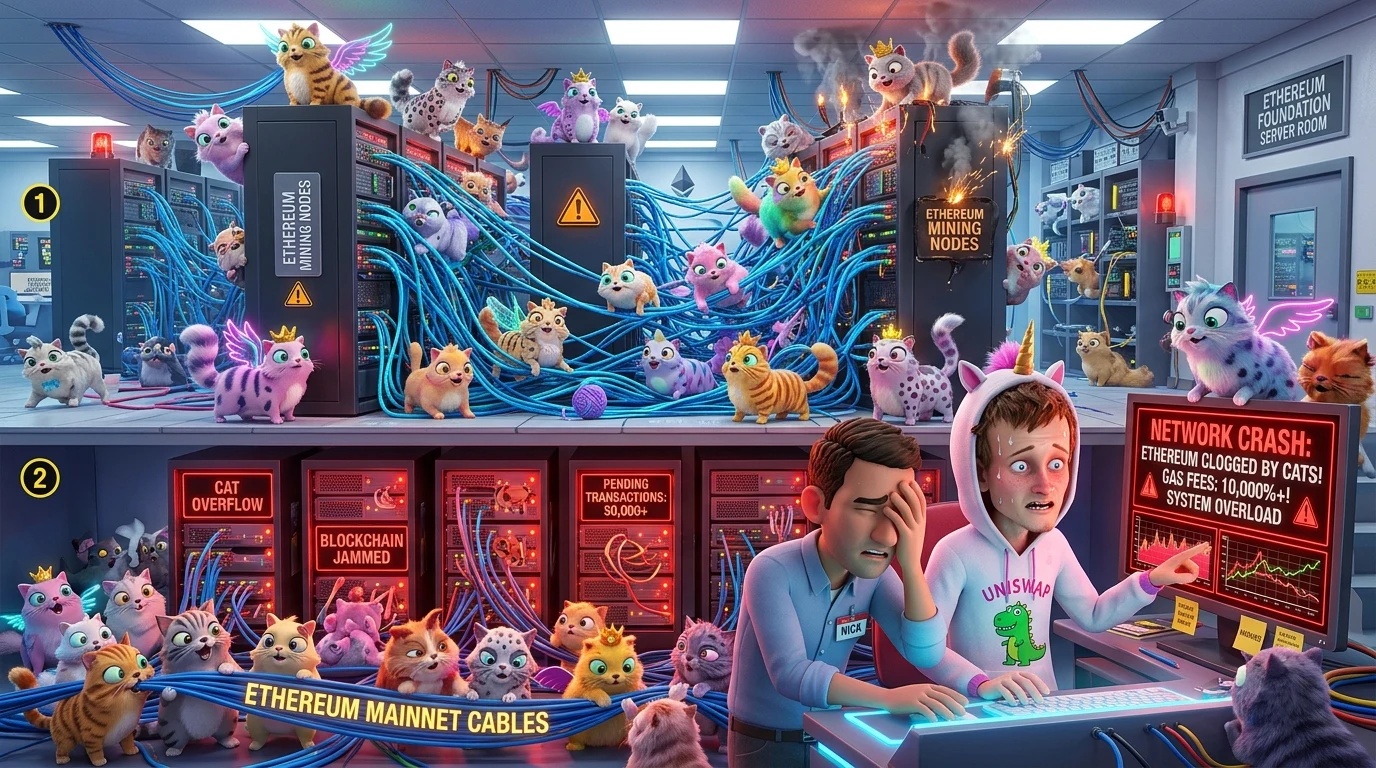
In December 2017, Canadian studio Axiom Zen launched CryptoKitties, the world's first viral non-fungible token (NFT) game. What started as a whimsical experiment in breeding virtual digital cats instantly exploded into a global speculative frenzy. Within days, CryptoKitties accounted for over 25% of all Ethereum network traffic, spiking gas fees by 10,000%, delaying global payments, and forcing Vitalik Buterin and the core developers to confront Ethereum's brutal scalability bottlenecks for the very first time.
Key Points
- Launched in late 2017 on the brand-new ERC-721 standard, CryptoKitties allowed users to buy, breed, and sell uniquely generated digital cats on Ethereum.
- A rare digital cat named 'Dragon' sold for 600 ETH (over $170,000 at the time), triggering an unprecedented global breeding and trading stampede.
- The viral game overwhelmed the entire Ethereum network, causing massive transaction backlogs and directly accelerating the development of Layer-2 rollups and sharding.
Chronological Timeline
Dieter Shirley and the Axiom Zen team present the ERC-721 non-fungible token concept.
Genesis Kitty #1 is minted, opening virtual breeding to the worldwide public.
CryptoKitties consumes 25% of Ethereum's total gas limit, creating a pending queue of 30,000+ txs.
Founder cat 'Dragon' fetches 600 ETH (~$170,000), making front-page mainstream headlines.
The bottleneck spurs Ethereum researchers to prioritize Layer-2 rollups, state channels, and Flow blockchain.
1. The Cute Viral Experiment on a Newborn Token Standard
In late November 2017, a Vancouver-based studio named Axiom Zen quietly released a playful project built by lead architect Dieter Shirley: a decentralized game called CryptoKitties [1].
Unlike standard ERC-20 tokens where every unit is identical, CryptoKitties introduced ERC-721 non-fungible tokens (NFTs)—each digital cat possessed a unique 256-bit genetic code ('Cattributes') determining its eye shape, fur pattern, and breeding cooldown [1].
Users could purchase two cats, breed them via smart contracts to produce rare offspring, and sell them on an open marketplace. Nobody, not even its creators, anticipated the tidal wave about to hit [1].
2. The 600 ETH 'Dragon' and Global Breeding Madness
Within a week of launch, CryptoKitties became an unstoppable internet obsession. Mainstream media from Bloomberg to the BBC covered the phenomenon as Silicon Valley venture capitalists and day traders rushed into virtual feline husbandry [2].
Prices exploded into astronomical territory. Genesis Cat #1 sold for 246 ETH ($117,000), and shortly after, an ultra-rare cat named 'Dragon' changed hands for 600 ETH (over $170,000) [2].
CryptoKitties is a huge step forward for the blockchain. It took complex smart contract logic and wrapped it into something everyone could love and understand.[2][3]— Vitalik Buterin (December 2017)
3. The 30,000 Transaction Queue and Network Paralysis
As hundreds of thousands of users frantically clicked 'Siring' (breeding) buttons, the Ethereum blockchain reached its breaking point [3].
CryptoKitties smart contracts alone devoured more than 25% of Ethereum's total block space. The pending transaction pool clogged with over 30,000 backlogged transfers, causing gas fees to spike by over 10,000% [3].
Regular cryptocurrency users attempting to send routine business transactions found their transfers frozen for days unless they paid exorbitant gas fees. Initial Coin Offerings (ICOs) were forced to delay their crowd-sales because the network was completely clogged by cartoon cats [4].
4. The Legacy: Forging the Path to Layer-2 Scaling
The CryptoKitties crisis was the definitive crucible that forced the Ethereum ecosystem to grow up. It proved unequivocally that a single viral consumer app could paralyze a monolithic Layer-1 blockchain [4].
In response, Axiom Zen spun out Dapper Labs and engineered the Flow blockchain, while Ethereum core developers accelerated research into Optimistic Rollups, ZK-Rollups, and Sharding to scale smart contracts horizontally [4].
The fluffy digital kittens of 2017 may have crashed the network, but their playful chaos built the technological foundation for modern Web3 scalability.
5. Evidence check: congestion, prices, and later scaling
Contemporary reporting supports the central event: CryptoKitties became a large share of Ethereum activity and pending transactions rose sharply [4]. Exact percentages depend on whether a source measured transactions, gas, or broader network traffic, so figures such as 25% should be read as a time-specific snapshot rather than a permanent share.
ERC-721 is an important part of the legacy, but the causal chain needs restraint. CryptoKitties helped make non-fungible assets understandable and exposed capacity constraints. It did not single-handedly create rollups, sharding, or Flow; those systems emerged from multiple technical and commercial decisions [2][4].
Key Takeaways for Investors & Builders
The Genesis of the ERC-721 Non-Fungible Standard
CryptoKitties proved that blockchains could manage discrete, uniquely identifiable digital property rather than just fungible money.
The Painful Wakeup Call on Base-Layer Scalability
Demonstrated that a single popular decentralized application could consume the entire computational bandwidth of a Layer-1 world computer.
Play-to-Earn Mechanics and Digital Provenance
Pioneered breeding algorithms (Cattributes) and genetic scarcity that laid the economic blueprint for the multi-billion-dollar NFT boom.
Continue reading
Explore the topic through other cases and contexts.

Sources & References
- [1]Source 1: Wikipedia: CryptoKitties & Ethereum Network CongestionWikipedia · 2017-12-01
- [2]Source 2: Ethereum EIPs: ERC-721 Non-Fungible Token StandardEthereum Foundation · 2018-01-24
- [3]Source 3: Wikipedia: History of Non-Fungible Tokens (NFT)Wikipedia · 2021-01-01
- [4]Source 4: Ethereum’s First ‘Killer App’ Is Here, and It’s a Game Where You Create Digital CatsMIT Technology Review · 2017-12-04