The Bitcoin Transaction That Needed One Signature from Orbit
SpaceChain's path began with a Qtum program on a Raspberry Pi-class board in low Earth orbit, then changed into a two-signature Bitcoin wallet test on the International Space Station. The verified record shows an orbital cosigner that still depended on ground stations, servers and the ordinary Bitcoin network.
Key Points
- The February 2018 payload ran a Qtum full-node program on a Raspberry Pi-class board and used a satellite-derived random seed to execute a predefined smart-contract test.
- SpaceX CRS-19 delivered a separate multisignature testbed to the ISS in December 2019, where NASA recorded relay and validation work between a ground station and Module-83.
- In August 2020, SpaceChain reported that a user signature and an orbital-wallet signature completed a Bitcoin transaction; ESA’s documented flow still ended with a terrestrial server broadcasting it to Bitcoin.
Chronological Timeline
SpaceChain is founded to combine open-source satellite payloads with blockchain applications.
A CZ-2D launch carries a Raspberry Pi-class board; ground commands trigger a predefined Qtum smart-contract test.
CRS-19 carries the payload, and NASA records installation of Nanoracks Module-83 for powered operations.
SpaceChain reports a multisignature transaction performed by co-founder and CTO Jeff Garzik through the ISS hardware.
A later payload launches for Ethereum multisignature services, while NASA records further Module-83 relay-and-validation testing.
1. The first payload was Qtum, not Bitcoin
SpaceChain's first orbital result came on February 2, 2018, when a CZ-2D rocket carried a Raspberry Pi-class development board running a Qtum full-node program. Six days later, the company's own release said a ground station uploaded a test command and the payload returned a random-number seed derived from satellite parameters. That seed drove a predefined smart-contract test, establishing that the small board could receive a command, compute with orbital inputs and return a result.[1][2]
That first mission established the project’s starting point: Qtum supplied the chain software, while the satellite supplied a remote execution environment and telemetry link. Antenna, power and platform checks came before the contract test. The later Bitcoin work would use a different payload and a different task—adding a cryptographic approval rather than running this initial Qtum computation.[1][2]
SpaceChain co-founder and CTO Jeff Garzik framed the result as a beginning rather than a finished network.[1]
the spirit of openness, transparency and collective collaboration[1]— Jeff Garzik, SpaceChain co-founder and CTO
2. CRS-19 carried a different experiment to the ISS
On December 5, 2019, SpaceX's CRS-19 cargo mission carried SpaceChain hardware toward the International Space Station through Nanoracks' commercial research platform. Nanoracks listed blockchain hardware-wallet technology among roughly 5,700 pounds of cargo. NASA's December 9 operations log then recorded the crew installing Module-83 into Platform 2 for powered operations.[3][4][9]
NASA described the investigation in restrained engineering terms: it would validate hardware and software and verify the relay and validation of transactions from a ground station to the blockchain-enabled payload and back. That description identifies the experimental boundary. The payload was a device in a communication loop; it was not a replacement for miners, terrestrial nodes or Bitcoin's peer-to-peer network.[4]
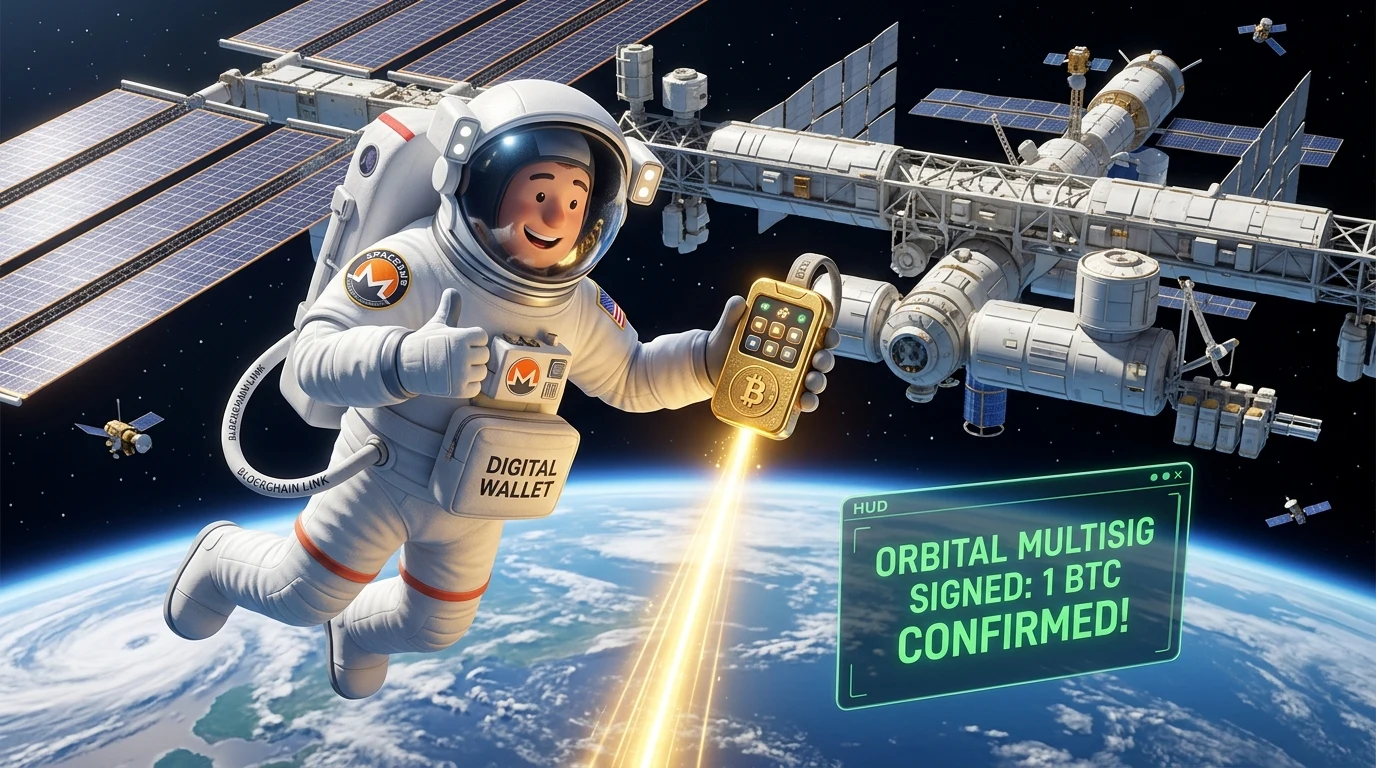
ESA's project page gives the wallet sequence. A user creates a transaction and applies the first private-key signature. A server packages and encrypts it. A ground station sends it to the wallet in orbit, which adds its private-key signature and returns the signed data. The ground station passes it back to the server, and the server broadcasts the transaction to the blockchain network.[5]
3. Two signatures made the orbital role visible
On August 18, 2020, SpaceChain announced that Jeff Garzik had performed a multisignature transaction through the ISS hardware. The company's release said encrypted data traveled through a ground station to the station, whose onboard wallet held a private key used to verify and approve the transaction. The release identified the hardware supplier as GomSpace and the program as an ESA Space Solutions Kick-start activity.[6]
The demonstrated security idea was separation of keys. A user applied the first signature, while hardware reached through a ground station held the second key. Compromising the user device alone would not supply both approvals. ESA’s two-signature sequence therefore placed one authorization step behind a physically remote communications path.[5][6]
That physical separation did not make the transaction independent of Earth. The server, ground station, encrypted link and final terrestrial broadcast were required steps. If any one of those services failed, the remote key could not complete the demonstrated path. Orbit changed where one secret was held; it did not remove the service chain around it.[5][6]
4. The claim was a milestone, not a new Bitcoin network
SpaceChain called the August event the first multisignature blockchain transaction in space. That priority claim belongs to the company, while NASA and ESA independently establish the payload, installation and two-signature design. The strongest conclusion is therefore narrow: the test showed that an orbital wallet could receive a partially signed transaction, add its signature and return the result for broadcast.[4][5][6]
Executing the multisignature transaction in space encapsulates our continuous efforts in building out an open-source blockchain-based satellite network that is secure and immutable.[6]— Jeff Garzik, SpaceChain co-founder and CTO
The quotation states an ambition as well as a result. NASA and ESA document a transaction-service experiment: the ISS device received data, added an approval and returned it. Bitcoin consensus and final broadcast continued through the existing terrestrial network. The milestone was a working orbital step inside that system, with a boundary readers can identify and operators can test.[4][5][6]
5. A later Ethereum payload clarified the product direction
On June 3, 2021, SpaceChain announced a later payload intended to add Ethereum multisignature services on the ISS. The announcement called it the project's fourth blockchain payload launch and said installation, testing and activation still had to occur. It did not establish that an autonomous Ethereum smart-contract network began operating at launch.[7]
NASA’s June 18 log again described Module-83 as hardware-and-software validation for relaying transactions to and from a ground station. That continuity clarifies the product direction. SpaceChain was developing remote signing and transaction-service infrastructure, with space hardware inserted into a chain of terrestrial operations and later extended to another smart-contract platform.[7][8]
The 2018 Qtum payload and the 2019–2020 Bitcoin testbed were therefore related experiments with different jobs. Qtum supplied the first chain software used for an orbital computation. Bitcoin supplied the later multisignature transaction used to demonstrate an orbital cosigner. Together they trace a move from proving that code could run on the payload to proving that the payload could hold one key in a real authorization flow.[1][4][5][6][8]
Key Takeaways for Investors & Builders
Orbit supplied a cosigner, not Bitcoin consensus
The user signed first, the orbital wallet added another signature, and a server on Earth broadcast the completed transaction to the normal Bitcoin network.
Physical distance trades one risk for a longer service chain
An orbital key can be harder to reach locally, but launch providers, ground stations, communications, servers and payload recovery become part of the product.
A demonstration should be judged by what crossed the link
The experiment showed receipt, authorization and return of a transaction. It did not demonstrate that Bitcoin consensus, connectivity or legal responsibility had left Earth.
Continue reading
Explore the topic through other cases and contexts.


Sources & References
- [1]Source 1: SpaceChain launch and first Qtum payload testSpaceChain via ACCESSWIRE · 2018-02-08
- [2]Source 2: SpaceChain Qtum payload launch detailsSpaceChain via PR Newswire · 2018-02-23
- [3]Source 3: Nanoracks CRS-19 cargo releaseNanoracks · 2019-12-10
- [4]Source 4: NASA ISS daily summary for Module-83 installationNASA · 2019-12-09
- [5]Source 5: ESA SpaceChain multisignature wallet projectEuropean Space Agency · 2019-11-27
- [6]Source 6: SpaceChain August 2020 multisignature announcementSpaceChain via PR Newswire · 2020-08-18
- [7]Source 7: SpaceChain June 2021 Ethereum payload announcementSpaceChain via PR Newswire · 2021-06-03
- [8]Source 8: NASA ISS daily summary for Module-83 testingNASA · 2021-06-18
- [9]Source 9: SpaceChain CRS-19 launch announcementSpaceChain via PR Newswire · 2019-12-05
- [10]Source 10: SpaceChain announces new commercial use cases for the blockchain industry in outer spaceSpaceNews