The No-Sell Button Nightmare: The $3.3M Squid Game Token Rug Pull
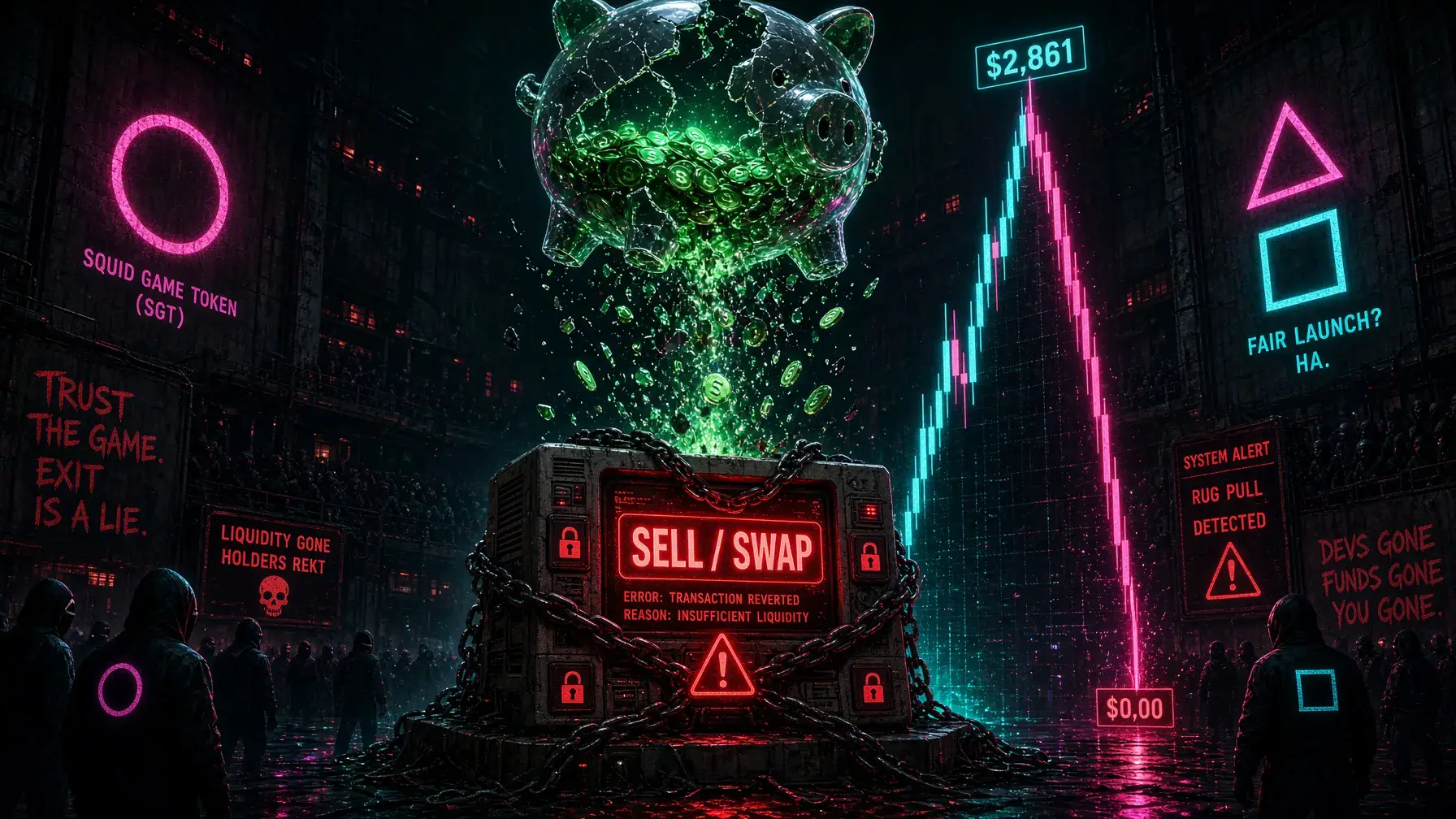
Riding the global hype of the Netflix hit series, the SQUID token skyrocketed from 1 cent to $2,861 before crashing to zero in a single second. The inside story of a malicious smart contract honeypot.
3-Minute Fast Briefing
- The ParadoxIn late October 2021, anonymous developers launched the SQUID meme token on BNB Chain, falsely claiming an official gaming partnership with Netflix's mega-hit series 'Squid Game'.
- The Turning PointWhile mainstream financial media uncritically covered its parabolic rise from $0.01 to $2,861, the developers embedded a hidden 'anti-dump' honeypot mechanism in the smart contract blocking retail sell orders.
- The LegacyOn November 1, 2021, the creators drained $3.38 million in BNB from the liquidity pool and vanished, sending the token crashing by 99.999% to $0.00079 in less than one second.
Chronological Timeline
Token launches on PancakeSwap with promises of a play-to-earn tournament game mimicking the TV show.
Major news outlets report on the token's 30,000% price surge, despite multiple user reports of disabled selling.
Developers execute the rug pull, withdrawing $3.38M in BNB and deleting all social media channels instantly.
The disaster triggers the widespread adoption of automated smart contract scanners like TokenSniffer.
1. Riding the Wave of Global Netflix Mania
In the autumn of 2021, the South Korean survival drama 'Squid Game' became the most-watched television series in Netflix history. Capitalizing on the global frenzy, anonymous developers launched the 'SQUID' token on BNB Chain's PancakeSwap decentralized exchange on October 26.
The project claimed to be building a Play-to-Earn (P2E) online tournament where players would pay entry fees to compete in rounds mimicking the TV show, with the final survivor claiming the prize pool.
Within days, the token price exploded from $0.01 to $4.50, then to $38, and past $100. Outlets including BBC, CNBC, and Business Insider ran glowing headlines celebrating the astronomical gains, sending retail FOMO into overdrive.
2. The Disabled Sell Button: A Textbook Honeypot
As paper millionaires attempted to realize their massive gains on PancakeSwap, they were greeted by error messages. Nobody could sell their tokens.
Security researchers examining the contract discovered a classic 'honeypot' mechanism buried within the smart contract logic. The transfer function required users to hold another unlisted token called 'Marbles' to authorize a sell, effectively preventing 99.9% of buyers from ever executing an exit transaction.
"Because nobody could sell, every single transaction on the blockchain was a buy order. The price chart could only move vertically upward, luring in more unsuspecting victims."
3. The 1-Second Crash: $2,861 to $0.00079
On the morning of November 1, 2021, the SQUID token reached an all-time peak of $2,861.91 per coin, giving the project a theoretical market capitalization in the billions.
At 05:40 UTC, the developers executed their predetermined exit. Using privileged admin functions, they drained all 3,380 BNB (worth approximately $3.38 million) from the PancakeSwap liquidity pool.
Without liquidity to back the market, the price plummeted from $2,861 to $0.00079 in a single blockchain block. The wipeout was 99.9999% complete in less than one second.
"A live Twitch streamer screamed in horror on camera as the green line instantly crashed through the floor into zero, shouting 'It went to zero! It's gone!'"
4. "We Are Too Stressed": The Audacious Exit Note
Moments after draining the funds, the creators posted a farewell message on their official Telegram group before deleting the channel, their Twitter handle, and their website.
"Someone is trying to hack our project. We are depressed and stressed out. Squid Game Dev doesn't want to run the project anymore. We are leaving."— SQUID Developers' Final Message
The stolen funds were funneled through the Tornado Cash cryptocurrency mixer to obscure laundering trails.
Netflix quickly issued a statement disavowing any connection to the token, but thousands of retail traders had already lost their entire life savings.
5. The Legacy: The Birth of On-Chain Safety Auditing
The Squid Game rug pull became a watershed moment for decentralized finance security education.
It demonstrated that rising prices are never proof of legitimacy in decentralized markets where contract code dictates liquidity access.
"Never enter a trade without checking smart contract permissions on tools like TokenSniffer or DexTools. If the contract restricts selling, you are not investing—you are donating to a thief."
The SQUID collapse established smart contract safety screening as an essential standard for modern crypto participants.
Key Takeaways for Investors & Builders
Understanding Smart Contract Honeypots
Malicious Solidity code can restrict transfer functions, allowing unrestricted buys while reverting all sell transactions for non-whitelisted wallets.
The Peril of Mainstream Media Hype
Financial news outlets frequently amplify crypto scams by reporting price gains without verifying technical legitimacy or code safety.
Zero Tolerance for Unlicensed IP Clones
Meme tokens exploiting copyrighted intellectual property without corporate backing are almost universally structured as fraudulent exit schemes.
Continue reading
Explore the topic through other cases and contexts.

Sources & References
- [1]Source 1: Squid Game Drama: Cultural Phenomenon and Token ParodyWikimedia Foundation · 2023-09-12
- [2]Source 2: Exit Scam & Meme Token Security Vulnerabilities in DeFiWikimedia Foundation · 2023-11-10
- [3]Source 3: Squid Game Crypto Token Collapses in Apparent ScamBBC News · 2021-11-02
- [4]Source 4: Squid Game: The Blockchain Play-to-Earn ScamFTI Consulting · 2022-02-14