Bitcoin Pizza Day: Laszlo Hanyecz and 10,000 BTC
On May 22, 2010, Laszlo Hanyecz exchanged 10,000 BTC for two pizzas in the first widely documented Bitcoin purchase of physical goods. Later dollar figures are arithmetic examples, not a claim about today's Bitcoin price.
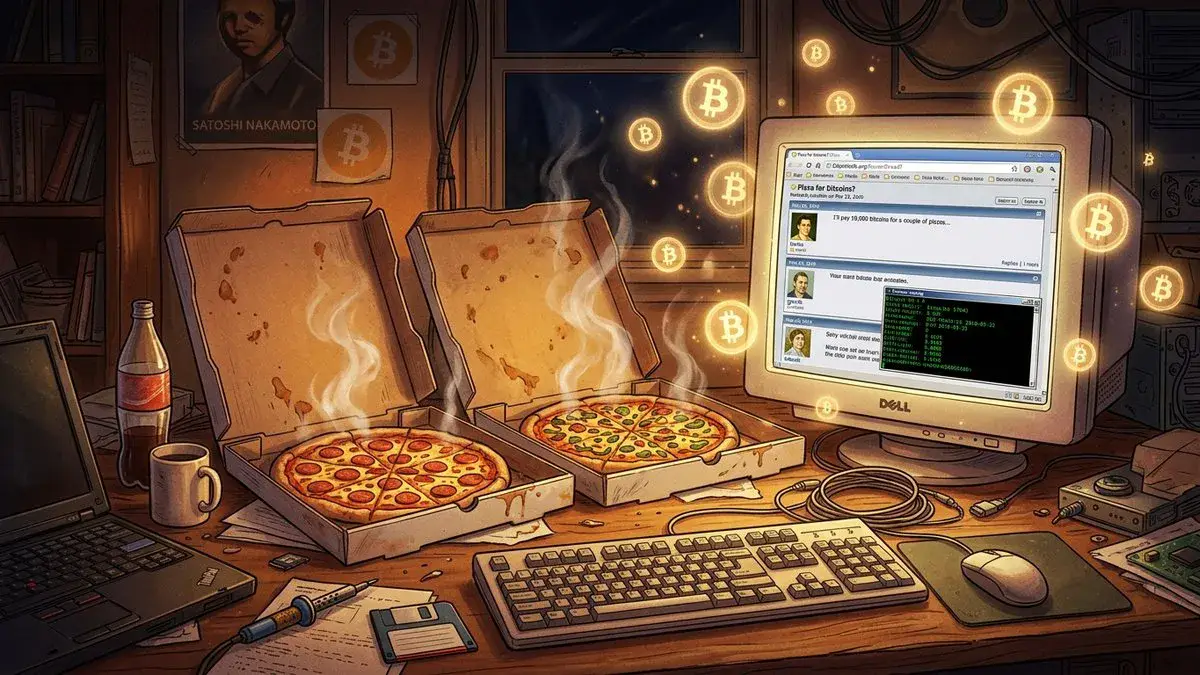
3-Minute Fast Briefing
- The ParadoxOn May 18, 2010, Laszlo Hanyecz offered 10,000 BTC for two delivered pizzas.
- The Turning PointOn May 22 he reported success and thanked jercos, later identified as Jeremy Sturdivant.
- The LegacyThe purchase became Bitcoin Pizza Day; later dollar comparisons depend on the BTC price assumed.
Chronological Timeline
Laszlo posts offer on Bitcointalk requesting 2 large pizzas for 10,000 BTC.
Hanyecz reports the exchange and thanks jercos.
Hanyecz says he can no longer generate thousands of coins daily and pauses more pizza trades.
The anniversary remembers the Bitcoin-for-pizza exchange.
1. “Pizza for bitcoins?”: The forum post that made history
On May 18, 2010, Laszlo Hanyecz, a programmer in Jacksonville, Florida, opened a Bitcointalk thread titled “Pizza for bitcoins?”. His offer was specific: 10,000 BTC for two large pizzas delivered to his home. A balance on a computer was about to become a request that somebody else had to fulfil.[4]
He was happy with homemade pizza or a delivery order, and wanted enough left for the next day. The toppings mattered too: ordinary vegetables and meat, with no unusual fish topping. These details gave the experiment a wonderfully ordinary objective. He wanted somebody to arrange food, not merely exchange one digital balance for another.[4]
The replies reveal an awkward gap between a quoted price and a usable payment. One participant said the coins could fetch about $41 on BitcoinMarket. That was a forum user’s market estimate, not an electricity-cost calculation or the pizza bill. On May 21, Hanyecz asked whether his offer was too low; the successful trade was still ahead.[4]
2. The trade closes and the pizza arrives
On May 22, Hanyecz reported that he had successfully exchanged 10,000 BTC for pizza and thanked jercos. Jeremy Sturdivant later identified himself as the other party in an interview with Bitcoin Who’s Who. He said they arranged the transaction through IRC, an online chat system.[4][5]
Sturdivant recalled paying online with an out-of-state card. He denied the story that he had been living in Britain, saying he had never travelled outside the United States. Even his memory of the pizza chain was imperfect: he remembered Domino’s, while acknowledging that the photographs showed Papa John’s. His recollection preserves the practical task of getting an order delivered, while leaving the chain’s identity to the photographs.[4][5]
Hanyecz’s completion post included a link to photographs. The public offer and follow-up make this a widely documented early Bitcoin purchase of physical goods. Sturdivant supplied the bridge to the ordinary food order; the transaction does not mean the pizza shop itself accepted BTC. Two people had made the digital payment useful for a very concrete purpose.[4][5]
3. Beyond pizza: The developer and his mining prototype
The pizza buyer was also building tools for Bitcoin. On May 10, 2010, Hanyecz had posted a Mac OS X package that used OpenCL to generate bitcoins with a GPU. The announcement names Mac OS X 10.6 or later and invites other users to test it. Eight days before the pizza offer, he was asking the community to try software he had built.[2][4]
His follow-up describes the software as a prototype and discusses how CPU work and GPU work could interfere. Performance depended on the machine and configuration; the post does not establish a universal tenfold improvement. Making the program useful meant testing the balance between the two kinds of processor, not simply adding a graphics card.[2][4]
On August 4, in the pizza thread, Hanyecz said he could no longer generate thousands of coins a day and was pausing further pizza trades. That is his own retrospective description of mining income, not an independently measured daily series. It explains why the offer had limits. The same person who had offered coins for dinner was now explaining why he could not keep doing so indefinitely.[2][4]
4. The arithmetic behind the $700 million price tag
The quantity on the original offer never changes: 10,000 BTC. The dollar number attached to it can change enormously depending on the price used. That distinction is what makes the familiar pizza comparison both memorable and easy to misuse.[4]
At an assumed $70,000 per BTC, 10,000 BTC equals $700 million, or $350 million per pizza. At an assumed $100,000 per BTC, the total is $1 billion. These are conditional calculations, not a current market quotation, the restaurant’s bill, or cash that Hanyecz realised from the trade.[4]
Looking backward also leaves out the uncertainty faced by the participants. Spending demonstrated one practical use for Bitcoin; it did not guarantee later adoption or make this particular purchase a necessary cause of every subsequent price increase. The achievement was smaller and more tangible: an offer became an exchange that other people could read about.[4]
5. The experiment remembered: Bitcoin Pizza Day
In 2019, Hanyecz discussed the purchase with CBS correspondent Anderson Cooper. He recalled the appeal of exchanging internet money for a physical good.[3]
That perspective returns the story to its original question: could these coins buy something outside a computer? The answer came through a person willing to organise the other side of the deal. Retrospective wealth calculations ask a different question, one the participants could not answer with knowledge of future prices.[3]
May 22 became known as Bitcoin Pizza Day. The enduring contrast is between the size of the digital payment and the ordinariness of the meal. As an interpretation of the episode, its strongest lesson is that using a new system can reveal possibilities that a balance alone cannot show. It offers no promise that spending or holding will produce the better financial outcome.[3]
Key Takeaways for Investors & Builders
A price is not a payment
The forum already discussed a market quotation. Arranging a meal required somebody willing to complete the other side of the trade.
A working prototype
Hanyecz’s May 2010 OpenCL post documents GPU mining experiments, with performance dependent on hardware and configuration.
Participation under uncertainty
Trying a new use and maximising a future investment return are different aims. The pizza trade illustrates the first without guaranteeing the second.
Continue reading
Explore the topic through other cases and contexts.


Sources & References
- [1]Source 1: Blockchain.com: Bitcoin transaction cca75078…Blockchain.com Explorer · 2010-05-22
- [2]Source 2: Hanyecz: Mac OS X build and OpenCL prototypeBitcointalk / Laszlo Hanyecz · 2010-05-02
- [3]Source 3: CBS: The story behind Bitcoin Pizza DayCBS News · 2019-05-22
- [4]Source 4: Bitcointalk: Pizza for bitcoins?Bitcointalk / Laszlo Hanyecz · 2010-05-18
- [5]Source 5: Bitcoin Who’s Who: Interview with Jeremy SturdivantBitcoin Who’s Who