Buried in the Landfill: The 8,000 Bitcoins Tragedy of James Howells
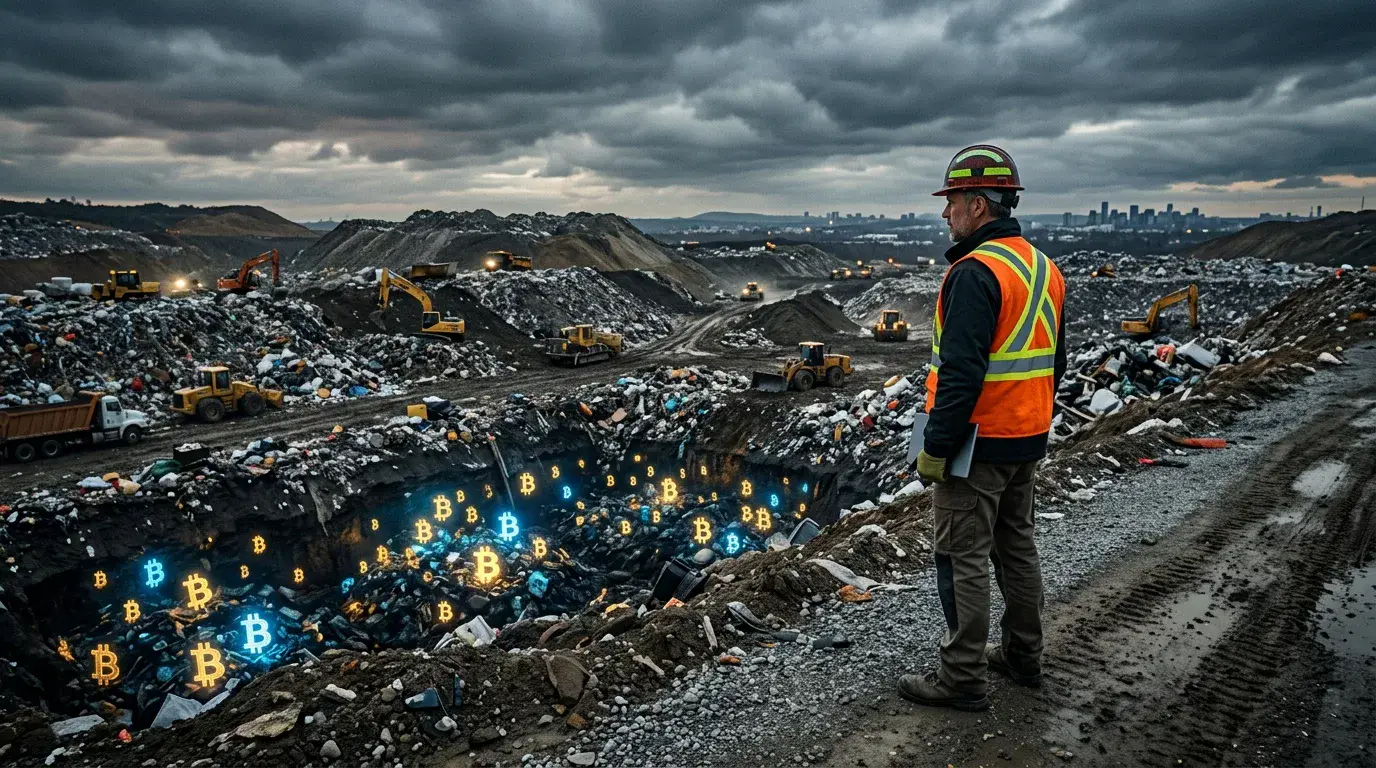
In 2013, an IT engineer accidentally threw away a hard drive containing 8,000 Bitcoins. Worth hundreds of millions of dollars today, he has spent over a decade battling city council to excavate 100,000 tons of trash.
3-Minute Fast Briefing
- The ParadoxIn August 2013, Welsh IT engineer James Howells accidentally tossed an old laptop hard drive into the trash during an office clean-up, unaware it held 8,000 freshly mined Bitcoins.
- The Turning PointRealizing his catastrophic mistake months later when Bitcoin crossed $1,000, he identified the exact dock and grid coordinate where the drive was buried under 100,000 tons of municipal waste in Newport, Wales.
- The LegacyFor over a decade, Howells proposed multi-million-dollar AI scanning excavations, promised 10% to the city, and filed a £495 million lawsuit against the council in a desperate bid to dig up his digital treasure.
Chronological Timeline
Howells mines 8,000 BTC on his Dell laptop in just 10 weeks when Bitcoin was virtually worthless.
After a lemonade spill damages the laptop, he saves the hard drive in a drawer but his partner accidentally throws it in the trash.
As Bitcoin hits $20,000, Howells approaches Newport City Council offering a 25% share of the fortune, but faces total rejection.
Backed by venture capitalists, Howells deploys AI sorting robots and files a £495 million damages lawsuit to force access to the site.
1. A Forgotten Drawer and a Fatal Clean-Up
In early 2009, when Bitcoin was known to only a few dozen cryptographers on the Cypherpunk mailing list, 24-year-old Welsh IT engineer James Howells decided to test the software. Leaving his Dell XPS laptop running overnight in his bedroom in Newport, South Wales, he accumulated 8,000 Bitcoins in approximately ten weeks. At the time, each coin was worth less than a fraction of a cent.
When his girlfriend complained about the noise and heat generated by the laptop fans, Howells stopped mining. Months later, a spilled glass of lemonade damaged the laptop. Howells dismantled the machine, salvaging the 2.5-inch hard drive and tossing it into a desk drawer alongside spare USB cables and old electronics.
"I had two identical hard drives in the drawer: one was blank, and one contained my Bitcoin wallet file. During a late-night bedroom clear-out in August 2013, the wrong drive ended up in a black trash bag."
The bag was placed in the household wheelie bin and collected by Newport City Council sanitation workers, destined for the Docksway landfill.
2. The $1,000 Realization: A Cold Sweat in November
For three months, Howells did not give the discarded drive a second thought. But in November 2013, Bitcoin made international headlines as its price skyrocketed from $100 to over $1,200. Suddenly, the 8,000 BTC he had left on the drive was worth $9.6 million.
A wave of panic struck Howells as he rushed to his desk drawer. He searched frantically through every cupboard, box, and shelf in his house, only to realize with sickening certainty that the drive had been tossed into the local dump three months earlier.
"I felt physically sick. I spoke to the landfill manager, and he looked at me like I had two heads. He said that a drive thrown away three months ago would be under 25,000 to 50,000 tons of compacted rubbish."
From that cold autumn evening, Howells' life transformed into a decade-long crusade against time, bureaucracy, and nature.
3. The AI Excavation Plan: High-Tech Treasure Hunting
Rather than giving up, Howells assembled an elite team of environmental engineers, data recovery specialists from Ontrack (the firm that recovered data from the Columbia space shuttle crash), and venture capital backers. He mapped the landfill's historical dumping records, identifying a specific 100,000-ton section of Cell 2 where his drive was buried.
Howells proposed a £10 million high-tech excavation plan that sounded like science fiction: deploying mechanical conveyor belts fitted with AI optical scanning cameras and automated Max-AI robotic sorting arms capable of inspecting thousands of objects per second.
"We are not just digging with bulldozers. We have robotic arms, environmental containment tents, and AI trained specifically on 2.5-inch hard drive geometry."
To sweeten the deal, Howells offered Newport City Council a 10% cut of the recovered fortune—which, with Bitcoin crossing $60,000 in 2021, amounted to over $50 million in direct community funding, plus £50 in crypto for every resident of Newport.
4. The Council's Brick Wall and the £495 Million Lawsuit
Despite the lucrative offer, Newport City Council repeatedly rejected his excavation requests without a face-to-face meeting. City officials cited severe environmental risks, noting that disturbing decades of buried municipal waste could release toxic leachate liquids and methane gas into the surrounding Severn estuary.
A council spokesperson stated that digging up the landfill was prohibited under environmental permit regulations, and that the likelihood of finding the drive in readable condition after years of pressure and moisture was near zero.
"The council is holding my private property hostage. Even if they think the odds are slim, the financial and technological backing we have mitigates every environmental concern."
In 2024, faced with statutory limitations, Howells escalated the conflict to the UK High Court, filing a £495 million damages lawsuit against Newport City Council to force judicial review or compensation.
5. The Legacy: A Monument to Blockchain's Ultimate Paradox
James Howells' story has become the defining parable of the cryptocurrency era. It encapsulates the uncompromising nature of decentralized mathematics: there is no customer support hotline, no password reset link, and no central bank capable of minting replacements for lost coins.
Today, out of the 19.8 million Bitcoins in circulation, blockchain analytics firm Chainalysis estimates that between 2.78 million and 3.79 million BTC (roughly 15% to 20%) are permanently lost in forgotten wallets, broken drives, and landfills.
"Lost coins only make everyone else's coins worth slightly more. Think of it as a donation to everyone."— Satoshi Nakamoto (2010)
Whether the Docksway landfill hard drive is ever recovered or remains forever entombed beneath the Welsh soil, James Howells' 8,000 Bitcoins stand as a permanent monument to the ultimate cost of digital sovereignty.
Key Takeaways for Investors & Builders
Private Keys Are Absolute: No Help Desk, No Undo
Unlike traditional bank accounts, blockchain architecture cannot reverse lost private keys. Physical custody requires redundant multi-location seed backups and fireproof storage.
The Sunk Cost Trap vs. Digital Scarcity
Howells' story illustrates how extreme digital appreciation creates immense psychological fixation, transforming a forgotten hobby file into an obsession.
Environmental Regulation vs. Property Rights
The Newport City Council's refusal highlights the collision between municipal environmental laws and decentralized private property rights.
Continue reading
Explore the topic through other cases and contexts.

Sources & References
- [1]Source 1: Bitcoin Core Development Team: Official Repository & Historical Commit LogsBitcoin Core Developers · 2013-08-10
- [2]Source 2: James Howells & The Newport Landfill Lost BitcoinsWikimedia Foundation · 2024-01-30
- [3]Source 3: Bitcoin Private Key Management & Irreversible Loss ArchitectureWikimedia Foundation · 2024-02-18
- [4]Source 4: Man loses bid to buy tip where Bitcoin fortune is buriedBBC News