From EOS to Vaulta: The Afterlife of a $4.1 Billion Token Sale
Block.one raised about $4.1 billion through the EOS sale. A token-payment halt, Antelope development, the Vaulta rebrand and a later leadership transition reshaped the network.
3-Minute Fast Briefing
- The ParadoxBlock.one’s 2017–2018 EOS sale raised approximately $4.1 billion, according to CoinDesk.
- The Turning PointIn December 2021, EOS block producers halted roughly 67 million EOS in future payments to Block.one.
- The LegacyVaulta was announced in March 2025; the A swap opened in May. La Rose later initiated a leadership transition.
Chronological Timeline
Block.one sells EOS tokens; CoinDesk reports approximately $4.1 billion raised.
Block.one agrees to a $24 million civil penalty without admitting or denying the findings.
Block producers stop roughly 67 million EOS scheduled for Block.one.
March 18 brand announcement precedes the May 14 opening of the 1:1 swap.
La Rose says on November 12 that he notified block producers on October 29; the election process was triggered.
1. A $4.1 billion sale, and a separate network
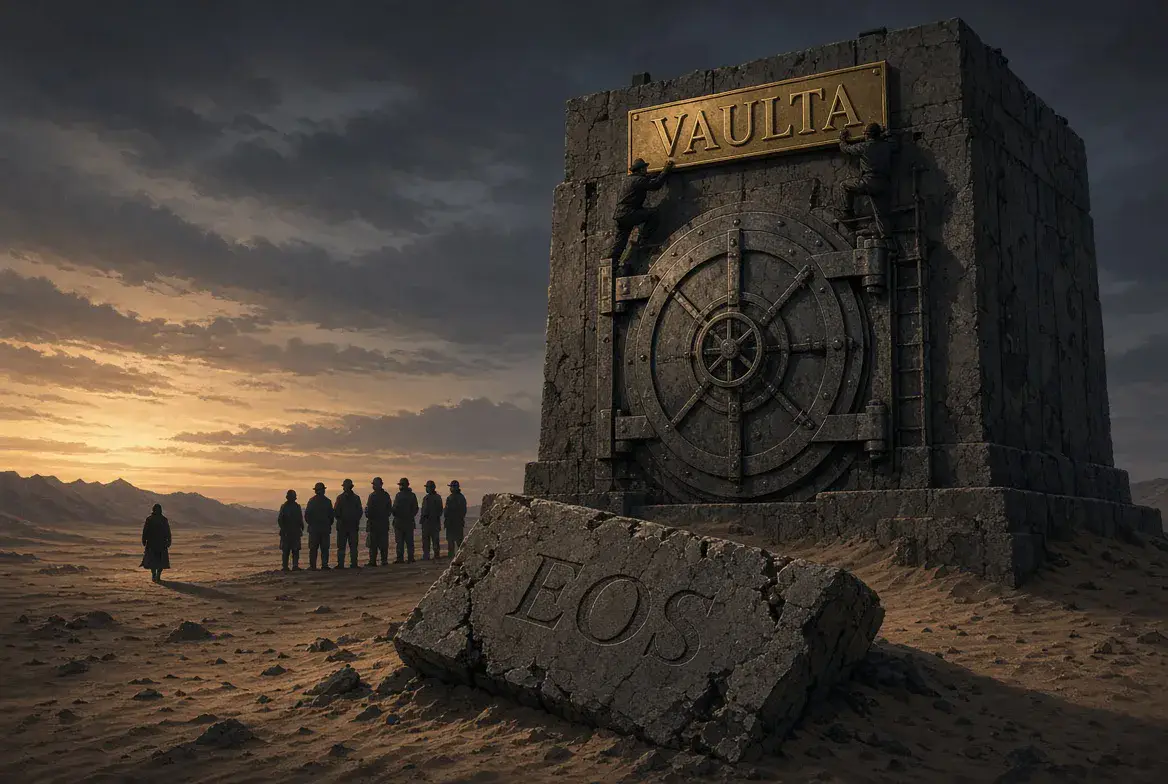
Between June 2017 and June 2018, Block.one sold tokens for the EOSIO project. The SEC later described an offering that raised several billion dollars in digital assets. It was a funding event of extraordinary scale, but the company receiving the assets and the public network built around its software were distinct actors.[1]
CoinDesk reported the sale at approximately $4.1 billion, a record for an ICO at the time. That estimate describes the offering, not a cash balance subsequently placed under the control of EOS token holders. The distinction matters when asking what the community could change after its relationship with the developer deteriorated.[9]
EOS used delegated proof of stake. As the ENF later explained, token holders select block producers, with the top 21 candidates by delegated stake producing blocks and approving network changes. This provided a route for collective decisions about chain rules. It did not make the sale participants shareholders exercising corporate votes at Block.one.[6]
2. The SEC settlement and the corporate split
On September 30, 2019, the SEC announced a settlement over Block.one’s unregistered offering. The company agreed to a $24 million civil penalty without admitting or denying the findings. The registration case was a specific regulatory action; it did not adjudicate every later complaint about how the EOS ecosystem had been supported.[1]
Those complaints became central to the split. In its May 2022 retrospective, the EOS Network Foundation accused Block.one of falling short on ecosystem funding and EOSIO development commitments. That is the foundation’s account of a dispute in which it was a participant, rather than an independent finding that every developer had stopped working.[5]
On January 10, 2021, Block.one announced that CTO Dan Larimer had departed to pursue personal projects. Later that year, EOS block producers approved support for the ENF under Yves La Rose. The network was building another channel for development funding instead of waiting solely for the original software company.[10][6]
3. Halting 67 million EOS in future payments
In December 2021, EOS block producers halted the release of roughly 67 million EOS scheduled for Block.one. The ENF’s subsequent account describes a code change stopping future payments. The target was the remaining token stream, not a recovery of all the money raised in the ICO.[5]
La Rose presented the decision as the community taking responsibility for its future. The concrete mechanism was network governance over those payments. Describing it as firing the founder can convey the rupture, but it should not be mistaken for removing Block.one’s executives through a shareholders’ meeting or transferring ownership of its assets.[5][6]
Technical independence followed a separate path. The ENF records the September 21, 2022 transition to the community-developed Antelope/Leap 3.1 codebase derived from EOSIO. Continuing and modifying an open-source implementation was a development change; it was not evidence that the community had acquired all of Block.one’s intellectual property.[6]
4. The Vaulta announcement and the later swap
On March 18, 2025, the network announced Vaulta and a Web3 banking strategy. Wealth management, payments, investment and insurance were its stated areas of focus. This was a repositioning of the project, not proof that the network itself had become a licensed bank or that every proposed financial service was operational.[7]
The token change came later. A May 7 announcement scheduled the EOS-to-A swap for May 14, and Vaulta’s May 14 notice said it was open at a 1:1 ratio. The March brand announcement, the proposed contract deployment and the reported opening of the swap were different steps.[4][11]
Vaulta said the existing chain, accounts, contracts and state history would continue. Its swap documentation also said supply, allocation and vesting were unchanged by the token replacement. The new symbol therefore did not wipe away the network’s history; it redirected the same infrastructure toward a different commercial ambition.[4][11]
5. A resignation, and governance still at work
On November 12, 2025, La Rose posted that he had informed Vaulta block producers on October 29 of his decision to step down as Foundation CEO. He said this triggered the regular on-chain process for choosing the network’s next representative or representatives. The statement establishes the start of that process, not a completed successor election.[8]
The departure returned the story to its central question: how does a network organize its work when a prominent leader leaves? The 2021 funding break and the later leadership process show particular governance mechanisms in use. Neither event establishes that every disagreement was resolved or that corporate control and network authority are interchangeable.[5][8]
From the token sale to Vaulta, fundraising, development funding, software maintenance and leadership turned out to be different problems. The durable lesson is narrower than a tale of complete collapse or guaranteed revival: money raised does not settle who must deliver the next stage, and a new name does not by itself demonstrate demand.[9][6][7]
Key Takeaways for Investors & Builders
Governance has a specific reach
Block producers could halt a future token stream; that did not transfer Block.one’s corporate assets.
Fundraising does not settle adoption
The $4.1 billion sale and sustained demand for applications are different measures of success.
A new direction on an existing chain
Vaulta’s swap retained network history and infrastructure while changing its name and commercial focus.
Continue reading
Explore the topic through other cases and contexts.

Sources & References
- [1]Source 1: SEC settlement of the unregistered offeringU.S. Securities and Exchange Commission · 2019-09-30
- [2]Source 2: EOS.IO background referenceWikimedia Foundation
- [3]Source 3: Proof of stake background referenceWikimedia Foundation
- [4]Source 4: May 7 swap schedule and continuity termsVaulta · 2025-05-07
- [5]Source 5: ENF retrospective on the funding dispute and token haltEOS Network Foundation · 2022-05-16
- [6]Source 6: ENF governance history and Antelope transitionEOS Network Foundation · 2023-02-21
- [7]Source 7: March 18 Vaulta strategy announcementEOS Network Foundation · 2025-03-18
- [8]Source 8: La Rose’s dated notice of resignation and election processYves La Rose · 2025-11-12
- [9]Source 9: CoinDesk’s historical report on the $4.1 billion saleCoinDesk (republished by CryptoNews.net) · 2019-09-17
- [10]Source 10: Block.one announces Larimer’s departureBlock.one · 2021-01-10
- [11]Source 11: May 14 confirmation that the swap is openVaulta · 2025-05-14