The 5 BTC Free Faucet: When Solving a Simple CAPTCHA Handed Out Fortunes to Casual Internet Surfers
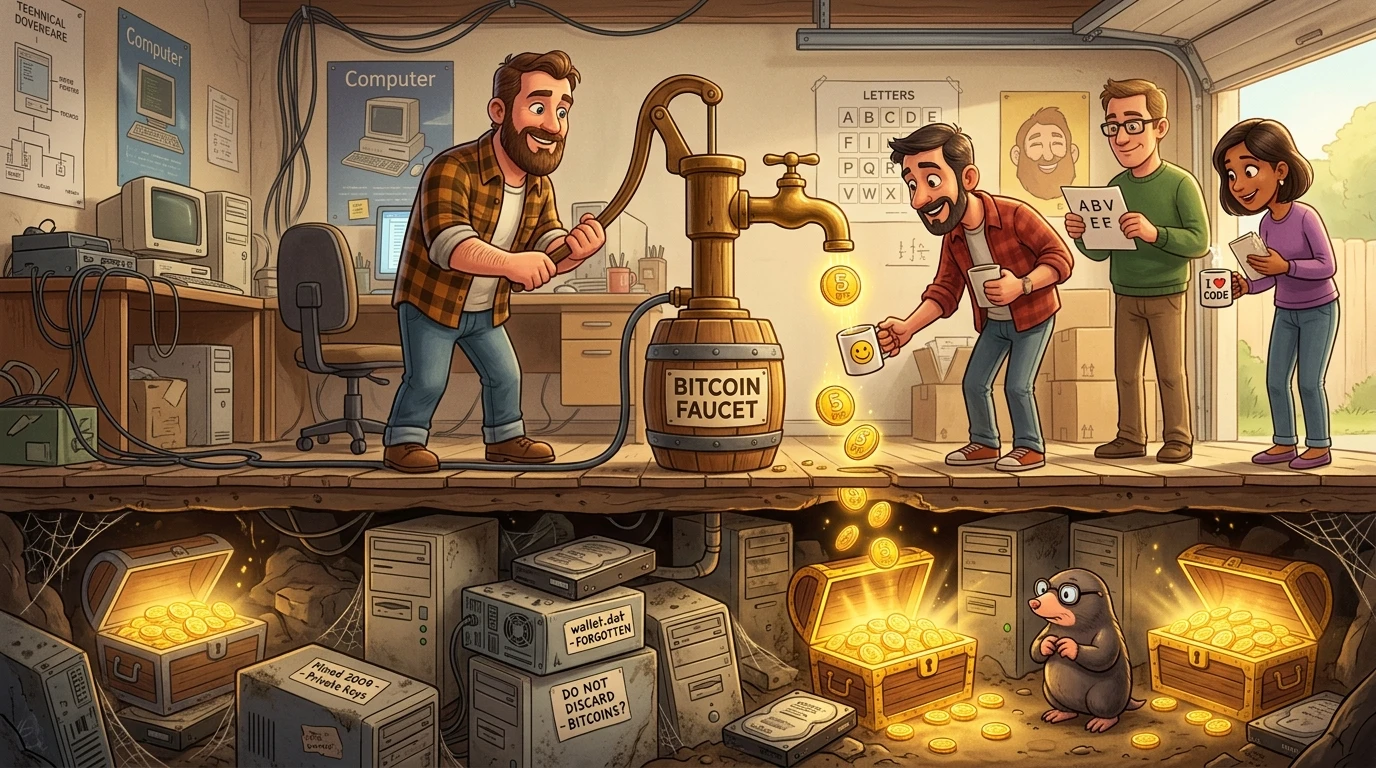
In June 2010, software engineer Gavin Andresen seeded a simple website called 'The Bitcoin Faucet' with 1,100 of his own Bitcoins. His rules were astonishingly simple: type in a 5-letter CAPTCHA to prove you are human, paste your wallet address, and receive 5 whole Bitcoins instantly for free. Over its operational lifespan, the faucet gave away 19,700 BTC to thousands of casual internet browsers who treated the coins as 5-cent digital toys, resulting in millions of formatted computers, forgotten hard drives, and legendary forum confessions.
Key Points
- In June 2010, Bitcoin core developer Gavin Andresen created freebitcoins.appspot.com, giving 5 BTC for free to any visitor who solved a CAPTCHA.
- Over two years, the faucet distributed 19,700 BTC (worth hundreds of millions of dollars today) to bootstrap user adoption across the globe.
- Because 5 BTC was worth less than $0.05 at the time, thousands of early users discarded their wallet.dat files, creating crypto history's most tragic 'lost fortune' confessions.
Chronological Timeline
Gavin Andresen announces 'The Bitcoin Faucet' on Bitcointalk, loading it with 1,100 of his own BTC.
Visitors solve a CAPTCHA and receive 5 BTC directly to their desktop client within seconds.
Early miners and Satoshi Nakamoto applaud the project; community members donate thousands of BTC to keep the faucet running.
As BTC hits $1 and then $10, payouts reduce to 0.05 BTC and smaller fractions before the faucet permanently closes after disbursing 19,700 BTC.
The faucet remains the single most successful open-source onboarding mechanism in digital currency history.
1. 'Free Bitcoins for Everyone' — The June 2010 Experiment
On June 11, 2010, an obscure Massachusetts software engineer named Gavin Andresen posted a new thread on the Bitcointalk forums with a simple headline: 'Bitcoin Faucet: Get 5 free Bitcoins for visiting a web page' [1].
At the time, Bitcoin was only seventeen months old. It had no exchange ticker, zero commercial adoption, and a market value of roughly $0.008 per coin [2]. Mining required running command-line software, and convincing strangers to install an experimental wallet was nearly impossible.
For my first Bitcoin coding project, I decided to build something that would make Bitcoin more accessible. I want Bitcoin to be a success, so I created a faucet to give away 5 BTC to anyone who visits.— Gavin Andresen (Bitcointalk, June 2010)
To fund the project, Andresen took 1,100 of his own personal Bitcoins—purchased for about $50 total—and loaded them into an automated Google App Engine server script at freebitcoins.appspot.com [1].
2. Solving a CAPTCHA to Receive a Future Empire
The mechanics were breathtakingly simple [2]. A user opened the webpage, typed in a standard 5-letter CAPTCHA image to prove they were a human rather than an automated bot, pasted their newly generated Bitcoin public address, and clicked 'Submit'.
Within seconds, the server broadcasted an on-chain transaction sending 5.00000000 BTC directly to the user's desktop client [1].
At the time, 5 BTC was worth less than four US cents—barely enough to purchase half a stick of chewing gum. To prevent abuse, Andresen limited payouts to one claim per IP address per day.
Curious forum browsers, chess club hobbyists, and cryptography enthusiasts clicked the button just to see the balance number tick upward in their desktop bitcoin-qt client, regarding it as an amusing geek novelty [3].
3. 19,700 Bitcoins Given Away to the Public
The faucet quickly became the primary onboarding funnel for the entire cryptocurrency ecosystem [2]. When Andresen's original 1,100 BTC reserve began running low, early Bitcoin miners and enthusiasts—including Satoshi Nakamoto—donated thousands of freshly mined coins to keep the faucet flowing.
Over its lifespan from 2010 to 2012, the faucet dispensed an astronomical total of 19,700 Bitcoins to ordinary internet users [3].
As Bitcoin's exchange rate climbed from fractions of a cent to $1.00 and eventually past $10.00, Andresen gradually reduced the payout from 5 BTC to 1 BTC, then to 0.05 BTC, before the site was finally retired [1].
4. The Tragic Legend of Formatted Hard Drives
Because those 5 BTC were received for free with zero financial effort, virtually no one treated them with seriousness [2].
For the vast majority of recipients in 2010, the Bitcoin wallet resided in a tiny file named wallet.dat on Windows XP netbooks, university lab desktops, or temporary gaming rigs.
When users upgraded their computers, reinstalled operating systems, or sold their laptops on eBay, they routinely wiped their hard drives without a second thought [3].
I remember clicking Gavin's faucet back in high school in 2010. I got 15 Bitcoins over three days, laughed at how stupid it was, and formatted that laptop six months later to install Skyrim. That lost laptop is now worth millions.— Anonymous Reddit User (2021)
Years later, thousands of frantic Reddit posts appeared from people scouring old family basements and attic closets, desperately searching for discarded laptops that once held Gavin's free faucet coins [2].
5. The Greatest Bootstrapping Triumph in Open Source History
Gavin Andresen's faucet was not a foolish mistake; it was an act of genius that literally bootstrapped Bitcoin into existence [1].
By giving away thousands of coins without charging a single penny, Andresen solved the classic 'Cold Start Problem': a payment network has zero value if no one owns the tokens, but no one wants to buy tokens if the network has zero users [3].
Satoshi Nakamoto was so impressed by Andresen's dedication and code that when Satoshi decided to step away from the project in 2011, he handed the cryptographic commit keys to the Bitcoin codebase directly to Gavin [2].
The 5 BTC faucet stands as an eternal monument to the cypherpunk era—a time when visionary builders gave away future fortunes for free, simply to give humanity a taste of financial self-sovereignty [1].
Key Takeaways for Investors & Builders
Zero-Cost Network Effect Bootstrapping
To create value in a peer-to-peer monetary system, distributing bearer tokens at zero monetary cost overcomes the initial 'empty network' paradox.
The 'Zero-Value' Perception Trap
When assets are acquired effortlessly for free, humans treat them with zero psychological value, leading to near-total abandonment of private key backups.
Radical Altruism in Cypherpunk Origins
Gavin Andresen giving away thousands of coins from his personal savings reflected the early ethos of collective mission over individual enrichment.
Continue reading
Explore the topic through other cases and contexts.


Sources & References
- [1]Source 1: Bitcoin Core Source Repository & Historical Genesis CodebaseBitcoin Core Developers · 2010-06-15
- [2]Source 2: Gavin Andresen: Lead Bitcoin Core Developer BiographyWikimedia Foundation · 2024-01-20
- [3]Source 3: History of Bitcoin & Early Cryptographic FaucetsWikimedia Foundation · 2024-03-01
- [4]Source 4: Free bitcoinsNakamoto Institute · 2010-06-11