Mike Novogratz: Galaxy Digital, the LUNA Tattoo and the Gap Between Promotion and Exposure
Mike Novogratz’s LUNA tattoo became a symbol of the Terra collapse. Galaxy’s 2022 CEO letter and its 2025 New York settlement reveal different parts of the story: public conviction, token sales and disclosure.
Key Points
- After Goldman Sachs and Fortress, Mike Novogratz built Galaxy Digital around digital-asset trading, investing, asset management and advisory services.
- Galaxy’s CEO letter dates its balance-sheet LUNA investment to the fourth quarter of 2020. In early January 2022, Novogratz publicized a wolf-and-LUNA tattoo.
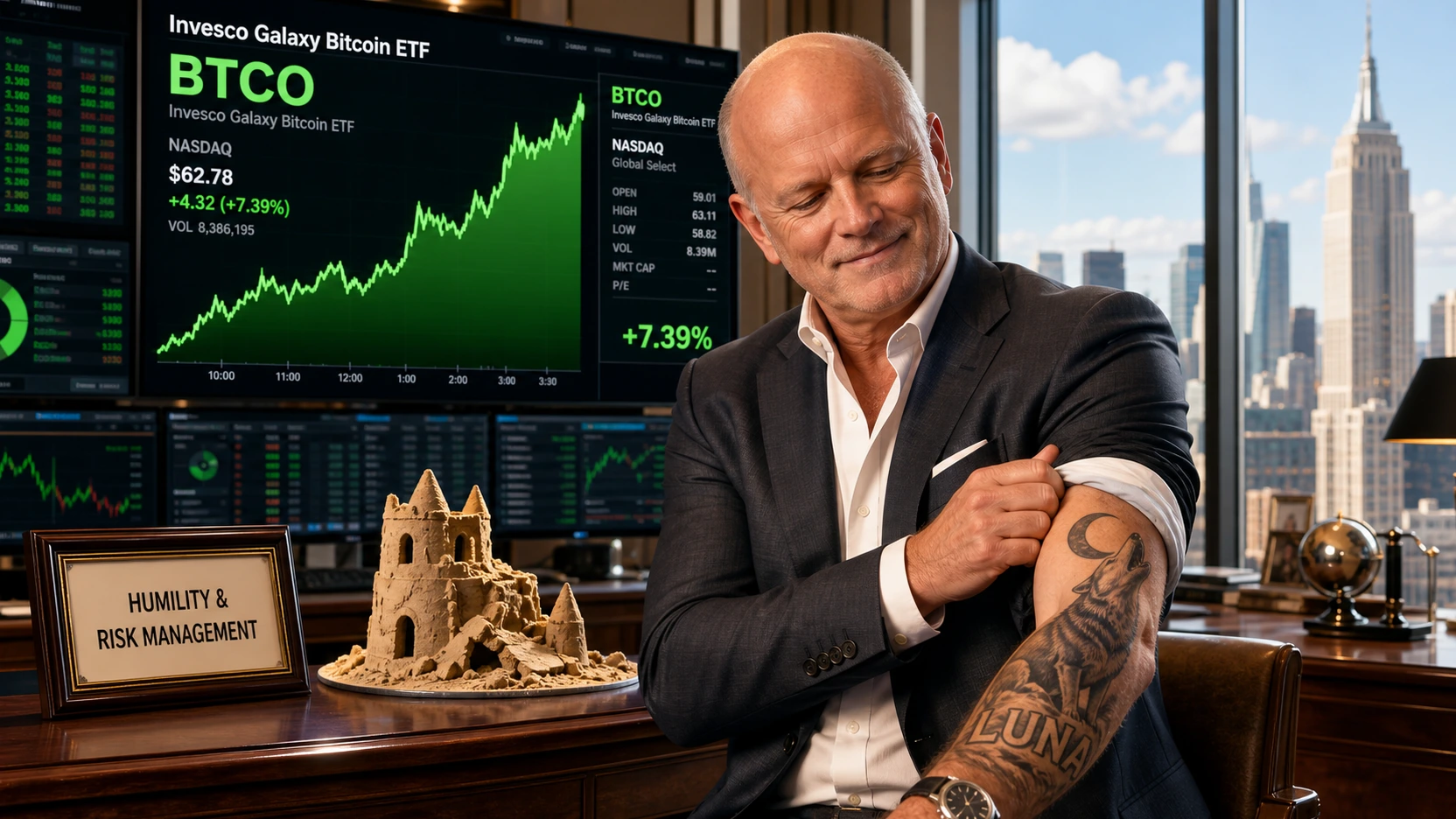
- The May 18, 2022 letter called the tattoo a reminder of humility. A 2025 New York settlement later addressed promotion alongside undisclosed sales; the Galaxy entities neither admitted nor denied the specified factual findings.
Chronological Timeline
Novogratz became a Goldman Sachs partner in 1998 and joined Fortress in 2002.
A proposed transaction described a digital-asset merchant bank with trading, principal investing, asset management and advisory businesses.
According to its later CEO letter, Galaxy used balance-sheet capital to invest in the token.
Novogratz posted his wolf-and-LUNA tattoo and called himself a Lunatic. The tweet reproduced in the later settlement displays January 4.
The failure of the old Terra ecosystem preceded the CEO letter; it was not the launch of the replacement LUNA chain.
Novogratz discussed Galaxy’s investment and risk management and addressed his tattoo.
Galaxy entities agreed to $200 million in disgorgement and conduct requirements, neither admitting nor denying the specified factual findings.
1. Wall Street experience becomes a digital-asset business
Novogratz came to crypto with experience at Goldman Sachs and Fortress. The January 2018 corporate announcement records his 1998 partnership at Goldman and his move to Fortress in 2002, where he served as chief investment officer of the macro fund. His official biography also records a Princeton economics degree and service as a US Army helicopter pilot.[5][6]
On January 9, 2018, Galaxy Digital, First Coin and Bradmer announced a proposed business combination. Its four stated business lines were trading, principal investing, asset management and advisory. This was a plan to build institutional financial services around digital assets; the announcement was conditional on completing the transaction.[5]
That business model matters to the LUNA story. Galaxy could invest its own capital while its founder publicly discussed the same assets. An audience seeing a prominent investor’s enthusiasm did not necessarily see the firm’s trading decisions.[5][4]
2. The investment and the tattoo
In his May 2022 letter, Novogratz dated Galaxy’s LUNA investment to the fourth quarter of 2020 and identified balance-sheet capital as the funding source. He described the initial thesis as blockchain payments. The asset in that account was LUNA: an investment in the token should not be confused with equity ownership of its developer.[1]
UST sought a one-dollar price through its relationship with LUNA. A user could exchange the tokens under the protocol’s mint-and-burn mechanism, linking demand for the stablecoin to demand for a volatile asset. Anchor later concentrated UST demand through high deposit returns; the CEO letter referred to an 18% yield, not a permanently fixed 20% promise.[1][4]
In early January 2022, Novogratz showed a wolf-and-LUNA tattoo and described himself as a Lunatic. The tweet reproduced in New York’s later settlement displays January 4. The post is evidence of public enthusiasm, not a statement of how much LUNA Galaxy still owned.[4]
The settlement’s account places that publicity alongside Galaxy’s token sales. Those are the Attorney General’s findings, not admissions by the respondents: the agreement expressly says they neither admit nor deny its factual findings in paragraphs 1–112.[4]
3. The collapse and what the numbers mean
In May 2022, UST lost its dollar peg and LUNA’s price collapsed. Falling confidence and redemptions could reinforce each other: more LUNA was needed to absorb a given dollar value as its price fell. This was the old Terra/LUNA ecosystem, before the replacement chain. Market incentives had failed to keep the stablecoin stable.[4][1]
Novogratz’s May 18 letter estimated that LUNA and UST had lost $40 billion in market value. Market value is a price-based estimate, not $40 billion of cash removed from a bank account. The destruction of that valuation affected investors with very different entry prices and exposures.[1]
UST was an attempt at creating an algorithmic stable coin that would live in a digital world. It was a big idea that failed.[1]— Mike Novogratz (2022)
The letter says Galaxy had taken profits; the later New York account says it had sold nearly all its LUNA before the crash. The distinction changes the story: public support for a token did not mean that the firm retained the same exposure as investors who continued holding it.[1][4]
4. A letter about humility, followed by a disclosure settlement
The open letter was published on May 18, after the collapse. It presented the CEO’s explanation of Galaxy’s investment and risk management. Its account should be read as the company’s perspective, not independent proof that every risk was disclosed to the public.[1]
My tattoo will be a constant reminder that venture investing requires humility.[1]— Mike Novogratz (2022)
The later record adds a different question. On March 27, 2025, the New York agreement took effect. It required Galaxy entities to pay $200 million in disgorgement and accept conduct requirements after the Attorney General’s findings concerning LUNA promotion and sales. The respondents neither admitted nor denied the factual findings specified in paragraph 118. This was a civil settlement, not a criminal conviction.[4]
The tattoo remained visible, but the investment position changed. The useful lesson is to distinguish an investor’s public narrative from actual exposure and disclosure. Humility in a retrospective letter does not by itself resolve that distinction.[1][4]
Key Takeaways for Investors & Builders
A price target is not a guarantee
UST depended on a volatile token and market incentives. Its failure illustrates how withdrawals and falling collateral value can reinforce one another.
Public conviction does not reveal a portfolio
A tattoo or endorsement says little about the promoter’s remaining exposure. The relevant questions include what was sold and what the audience was told.
Separate the record from the retrospective
The CEO’s account, the mechanism and the later regulatory settlement answer different questions. Neither a market-value loss nor a settlement should be rewritten as proof of every later failure or a criminal conviction.
Continue reading
Explore the topic through other cases and contexts.



Sources & References
- [1]Source 1: A letter from our CEO, Mike NovogratzGalaxy
- [2]Source 2: A Letter From Galaxy Digital CEO Mike NovogratzMarkets Media
- [3]Source 3: Novogratz Breaks Silence on Luna Tattoo After Crypto RoutBloomberg
- [4]Source 4: New York Attorney General: Galaxy assurance of discontinuance (2025)New York State Office of the Attorney General
- [5]Source 5: January 2018 Galaxy business-combination announcementBradmer Pharmaceuticals Inc.
- [6]Source 6: Mike Novogratz official biographyGalaxy Gives