The 2014 MIT Bitcoin Experiment: 3,108 Students, $100 Airdrops, and the Legend of the Expensive Sushi
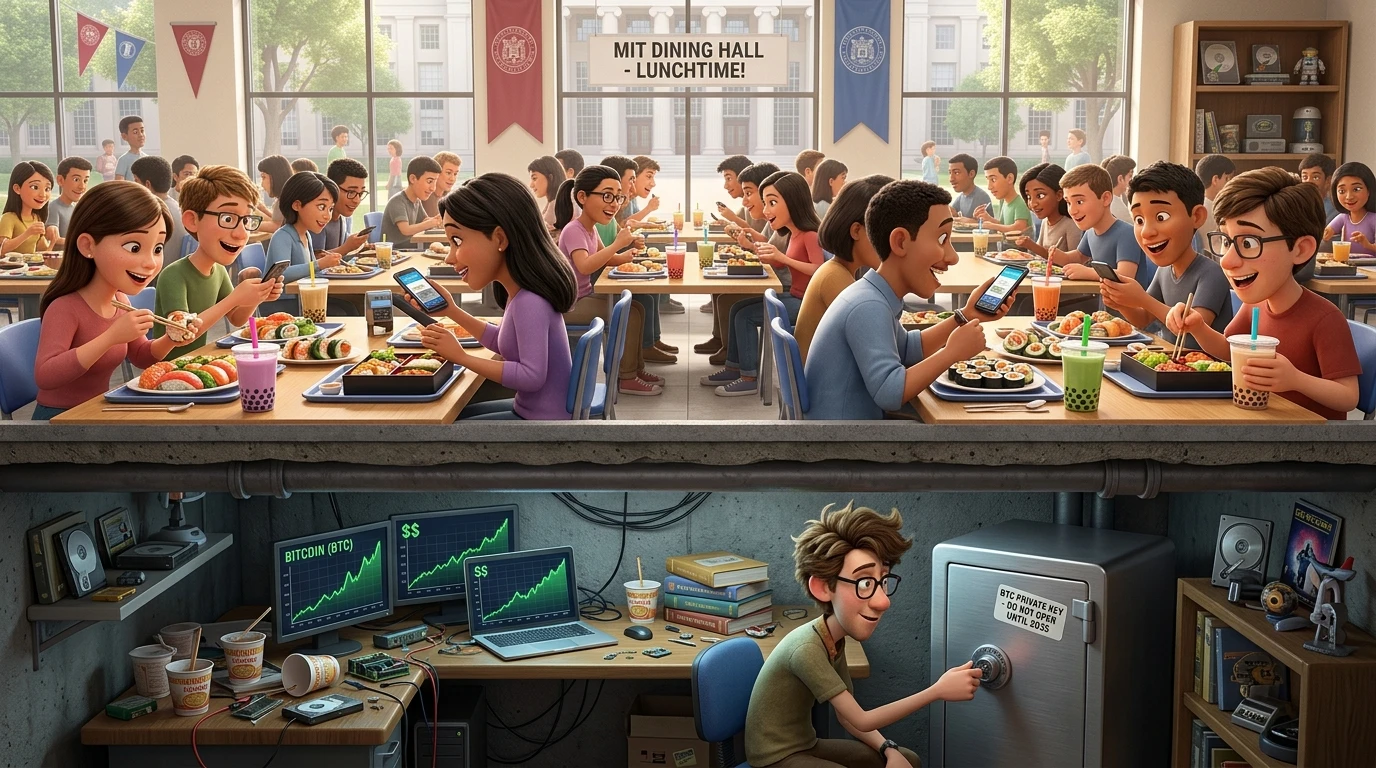
In the fall of 2014, two MIT students raised $500,000 from Wall Street alumni to execute the most ambitious social experiment in cryptocurrency history: giving $100 worth of Bitcoin (roughly 0.3 BTC) to all 3,108 undergraduates with zero strings attached. What followed was a behavioral economics rollercoaster of campus wallet brokers, students trading their Bitcoin for lunch at a local sushi joint, lost private keys, and a tiny group of patient HODLers whose college grants exploded by 13,000% over the next decade.
Key Points
- In autumn 2014, MIT undergraduates Jeremy Rubin and Dan Elitzer raised half a million dollars to airdrop $100 in BTC (~0.3 BTC) to every undergraduate on campus.
- More than 70% of participating students quickly spent their Bitcoin on takeout sushi, beer, and pizza at local Cambridge merchants who rushed to install point-of-sale crypto terminals.
- A decade later, the $100 sushi lunch had turned into an eight-figure behavioral economics case study, contrasting forgotten wallets with students who used their holdings to pay off student debt and fund blockchain startups.
Chronological Timeline
Jeremy Rubin and Dan Elitzer secure funding from high-frequency traders and MIT alumni.
3,108 undergraduates register and claim approximately 0.3 BTC ($100) each into newly created wallets.
Local restaurants like Thelonious Monkfish accept BTC; thousands of satoshis are spent on spicy tuna rolls.
Economists publish research analyzing why delayed wallet access caused 50%+ of early adopters to cash out.
Students who held their keys see their $100 grant surge to tens of thousands of dollars, seeding a new generation of Web3 founders.
1. Half a Million Dollars Falling from the Sky
In the spring of 2014, when Bitcoin was still viewed by mainstream media as an illicit currency for darknet markets, two ambitious undergraduates at the Massachusetts Institute of Technology—Jeremy Rubin and Dan Elitzer—conceived an unprecedented social experiment [1].
They approached Wall Street hedge fund managers, high-frequency traders, and tech-savvy MIT alumni with a bold pitch: fund a $500,000 grant pool to distribute $100 in Bitcoin to every single undergraduate student on the MIT campus [2].
We wanted to see what happens when you give access to a frictionless, borderless digital asset to thousands of the smartest young minds on the planet all at once. It was about creating an organic cryptocurrency economy from scratch.— Jeremy Rubin (Co-Founder, MIT Bitcoin Project)
By October 2014, the platform was live. Exactly 3,108 undergraduate students—more than half the student body—completed the verification questionnaire and received approximately 0.3 BTC deposited directly into their personal wallets [1].
2. Campus Brokers and the Great Sushi Rush
In 2014, setting up a secure cryptocurrency wallet required downloading client software, synchronizing blockchain headers, and manually backing up seed phrases. For hundreds of non-technical students majoring in humanities or architecture, this process was utterly baffling [1].
A spontaneous underground economy of student 'crypto brokers' quickly emerged across dormitories. Computer science majors offered to set up wallets for classmates in exchange for a slice of the Bitcoin allotment or a free meal.
One student, Van Phu, became legendary for helping dozens of peers configure their keys, accumulating a substantial hoard of early satoshis. But rather than holding the coins, he and hundreds of other students made a beeline for Thelonious Monkfish, an Asian fusion restaurant in Central Square that had just installed a Bitcoin point-of-sale iPad [2].
I set up wallets for my friends, collected the fee in Bitcoin, and immediately spent it all on spicy tuna rolls and sashimi at the local sushi place. That sushi lunch eventually cost me more than a luxury sports car.— Van Phu (MIT Alumnus & Crypto Founder)
Within weeks, local merchants, pizza parlors, and campus convenience stores were inundated with Bitcoin payments, as students traded digital gold for immediate dopamine [1].
3. The MIT Sloan Behavioral Economics Discovery
The experiment was not just a stunt; it was a goldmine for behavioral economists at the MIT Sloan School of Management [3]. Researchers Christian Catalini and Catherine Tucker tracked transaction telemetry to analyze how early access influenced adoption.
Their findings revealed a striking psychological paradox: students who received their Bitcoin immediately were far more likely to hodl and explore the technology, whereas students whose wallet access was artificially delayed by just two weeks were twice as likely to cash out into fiat dollars instantly [3].
Once students felt that Bitcoin was a mainstream commodity rather than an exclusive privilege, their speculative curiosity evaporated, prompting them to treat the $100 grant as ordinary grocery pocket money [3].
4. The 10-Year Divergence: $100 vs. Life-Changing Fortunes
A decade after the autumn 2014 airdrop, the fate of those 3,108 students had split into two vastly different realities [1].
More than 70% of the participants had either spent their 0.3 BTC within the first six months or lost their private keys when their laptops were formatted, discarded, or damaged during graduation moves.
However, the minority of students who kept their private keys backed up on encrypted flash drives or paper backups witnessed an astonishing 13,000%+ explosion in value [2]. By 2024–2025, that single $100 campus gift had ballooned to over $25,000 to $30,000 per student.
Scores of MIT graduates used their forgotten Bitcoin reserves to pay off stubborn student loans, make down payments on suburban houses, or leave corporate engineering jobs to launch Web3 startups and venture funds [1].
5. The Legacy of the First Campus Crypto Ecosystem
The MIT Bitcoin Project proved that technological revolutions are driven not by passive academic theories, but by putting sovereign instruments directly into the hands of real users [1].
The project directly incubated the MIT Digital Currency Initiative (DCI), which went on to hire core Bitcoin developers like Wladimir van der Laan and Cory Fields, anchoring global Bitcoin protocol research within the university [3].
For the thousands of students who ate the 'most expensive sushi in Boston,' the lesson was indelible: true monetary innovations rarely announce their future value with fanfare—they appear quietly as small gifts waiting for patient hands [2].
Key Takeaways for Investors & Builders
The Friction of Early Technology Adoption
The MIT experiment demonstrated that free bearer assets are rapidly liquidated for immediate consumption when user onboarding friction is high.
Private Key Retention in Mass Onboarding
Without institutional or social recovery mechanisms, self-custody airdrops inevitably suffer high attrition rates as users lose passwords and hard drives.
The Delayed Gratification Premium in Crypto
A nominal $100 educational gift became life-altering capital strictly for those who treated cryptographic money as long-term monetary infrastructure.
Continue reading
Explore the topic through other cases and contexts.


Sources & References
- [1]Source 1: The Tech (MIT Official Newspaper): Bitcoin Project to Airdrop $100 to UndergradsThe Tech · 2014-04-30
- [2]Source 2: MIT Center for Information Systems Research: The MIT Bitcoin ExperimentMIT · 2014-05-01
- [3]Source 3: Wikipedia: History of Bitcoin & Early University AdoptionWikipedia · 2023-01-01
- [4]Source 4: Bitcoin study: period of exclusivity encourages early adoptersMIT News · 2017-07-13