Ambush at Glen Park Library: Ross Ulbricht, Dread Pirate Roberts, and Bitcoin's Darknet Genesis
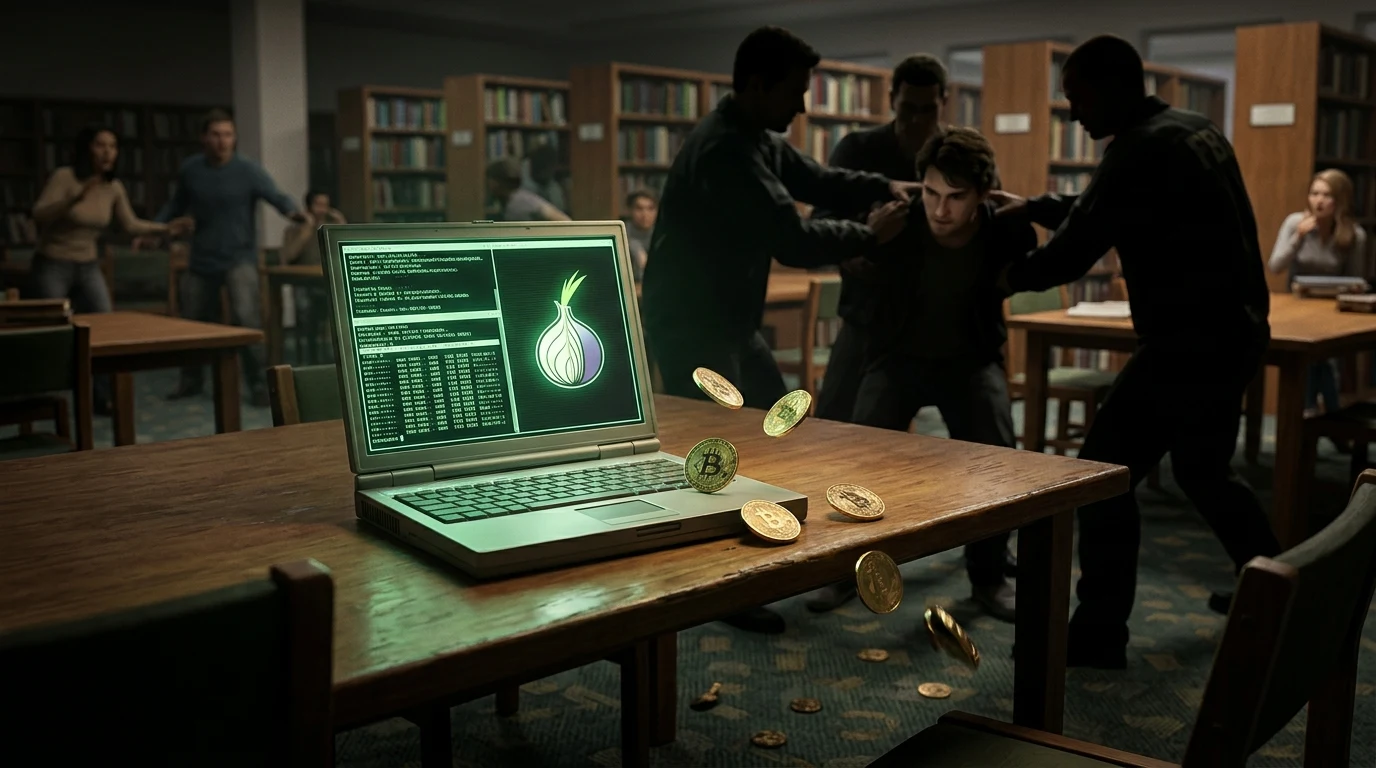
On October 1, 2013, inside the quiet Glen Park Public Library in San Francisco, undercover FBI agents staged a fake domestic argument to distract a 29-year-old idealist named Ross Ulbricht before slamming his open laptop shut. This is the dark, gripping history of Silk Road—the illicit darknet bazaar that processed $1.2 Billion in Bitcoin transactions and proved to Wall Street and Washington that digital currency could power an untraceable shadow economy.
Key Points
- In January 2011, libertarian physics graduate Ross Ulbricht launched the Silk Road on the Tor network, combining end-to-end encryption with Bitcoin to build the first darknet marketplace.
- Silk Road processed 9.5 million BTC in volume over 30 months, establishing Bitcoin's first real-world transactional price discovery and liquidity flywheel.
- On October 1, 2013, FBI agents ambushed Ulbricht in a San Francisco library with his laptop logged into the 'Mastermind' admin account, leading to two life sentences without parole.
Chronological Timeline
Ross Ulbricht grows hallucinogenic mushrooms in a cabin and lists them on the Tor network.
Adrian Chen publishes 'The Underground Website Where You Can Buy Any Drug Imaginable', sending BTC soaring from $9 to $30.
FBI agents tackle Ulbricht in a San Francisco library, seizing his unlocked Samsung laptop.
Judge Katherine Forrest sentences Ulbricht to two life sentences plus 40 years without parole.
US DOJ seizes 69,370 BTC from 'Individual X' linked to Silk Road hacker proceeds.
1. The Texas Mushroom Cabin and the Tor Revolution
In late 2010, in a remote cabin near Austin, Texas, a 26-year-old materials science graduate named Ross Ulbricht built an underground economic experiment. Heavily influenced by free-market economist Ludwig von Mises, Ulbricht believed government prohibition of substances was an unjust infringement on human autonomy [1].
By combining the anonymizing Tor network (The Onion Router) with a newly invented digital currency called Bitcoin, Ulbricht created Silk Road in January 2011. Operating under the pseudonym 'Dread Pirate Roberts' (DPR), he launched a platform with Amazon-style seller ratings, escrow protection, and PGP encryption [1].
Silk Road was founded on the philosophy that people should have the right to buy and sell whatever they wish, so long as they aren't hurting anyone else.[3][2]— Dread Pirate Roberts (Silk Road Forum, 2012)
2. The Gawker Explosion and Bitcoin's First Liquidity Flywheel
On June 1, 2011, tech blog Gawker published a viral exposé titled 'The Underground Website Where You Can Buy Any Drug Imaginable.' Within 48 hours, tens of thousands of users flooded the site [2].
At the time, Bitcoin had virtually zero commercial use. Silk Road changed that overnight: over its 30-month lifespan, the marketplace processed 9,519,664 Bitcoins—generating hundreds of millions of dollars in commissions and creating Bitcoin's first real-world transactional velocity and price discovery [2].
US Senator Charles Schumer held a press conference calling on the DEA and DOJ to shut down Bitcoin and Silk Road immediately, inadvertently giving Bitcoin free front-page global publicity [2].
3. The Digital Trail and the Glen Park Library Staging
A joint federal task force comprising the FBI, DEA, and IRS spent two years hunting DPR. The fatal breakthrough came not from cracking Bitcoin or Tor cryptography, but from old-school digital forensics [3].
IRS Special Agent Gary Alford discovered that in January 2011, a user named 'altoid' had posted on BitcoinTalk promoting Silk Road—and months later, the same 'altoid' had posted asking for programming help using the email address rossulbricht@gmail.com [3].
Federal agents tracked Ulbricht to the Glen Park Public Library in San Francisco on the afternoon of October 1, 2013. Knowing that if Ulbricht closed his laptop the full-disk encryption would lock them out forever, the FBI orchestrated a high-stakes psychological trick [3].
4. The Tackle at 3:14 PM: Keeping the Laptop Open
At 3:14 PM, two undercover agents staged a loud, violent domestic fight directly behind Ulbricht's desk in the science fiction section. As Ross turned around in shock, an agent lunged across the table and grabbed his unlocked Samsung 700Z laptop [4].
On the glowing screen, the terminal was logged into the Silk Road administrative control panel under the alias 'Mastermind', with a chat window open to an undercover agent. The FBI had captured the ultimate cryptographic smoking gun, seizing 144,336 Bitcoins directly from his cold wallet [4].
5. Two Life Sentences and the Shadow Legacy of Bitcoin
In May 2015, Federal Judge Katherine Forrest sentenced Ross Ulbricht to two consecutive life terms plus 40 years without the possibility of parole—a sentence harsher than many violent cartel leaders [4].
The US Marshals subsequently auctioned off Ulbricht's seized Bitcoin in 2014 and 2015 for roughly $18 Million (today worth over $9 Billion), with billionaire venture capitalist Tim Draper buying large tranches [4].
Silk Road proved to the world that decentralized, uncensorable digital cash was technically viable. While it tarnished Bitcoin's early reputation with the darknet label, it paradoxically demonstrated the unstoppable monetary power of Satoshi's creation.
Key Takeaways for Investors & Builders
Pseudonymity is Not Anonymity
Bitcoin's public ledger is permanent; forensic blockchain analytics tools (Chainalysis) proved that every illicit transaction leaves an immutable trail for law enforcement.
Bootstrapping Moneyness via Censorship-Resistant Commerce
Silk Road provided Bitcoin's initial utility floor and price discovery, proving money derives value from utility in uncooperative transactional environments.
The Cypherpunk Boundary of Free-Market Libertarianism
Ulbricht's belief in absolute free-market Austrian economics clashed with sovereign criminal statutes, transforming him into a martyr for decentralization advocates.
Continue reading
Explore the topic through other cases and contexts.
Sources & References
- [1]Source 1: Ross Ulbricht: Silk Road Founder, Arrest, and Federal Trial BiographyWikimedia Foundation · 2024-02-10
- [2]Source 2: Silk Road (Marketplace) Operation, Seizure, and Legal PrecedentWikimedia Foundation · 2024-01-15
- [3]Source 3: Ross Ulbricht Found Guilty on All Silk Road CountsU.S. Department of Justice · 2015-02-04
- [4]Source 4: Ross Ulbricht Sentenced to Life for Creating and Operating Silk RoadU.S. Immigration and Customs Enforcement · 2015-05-29