MIT’s Digital Diploma: A Record That Could Leave Campus
In 2017, MIT offered a group of graduates a diploma they could keep on a phone and share for verification. Blockcerts changed how a record could travel, while keeping the question of who issued it at the center.
3-Minute Fast Briefing
- The ParadoxMIT’s 2017 pilot offered digital diplomas to a cohort of 111 graduates alongside paper credentials.
- The Turning PointThe diploma file stayed outside Bitcoin; a hash-based proof connected it to a blockchain record.
- The LegacyChecking an unchanged file, recognizing its issuer and checking revocation are distinct tasks.
Chronological Timeline
MIT Media Lab and Learning Machine develop Blockcerts.
MIT describes the summer pilot and its recipient-owned digital records.
The graduate could carry the record
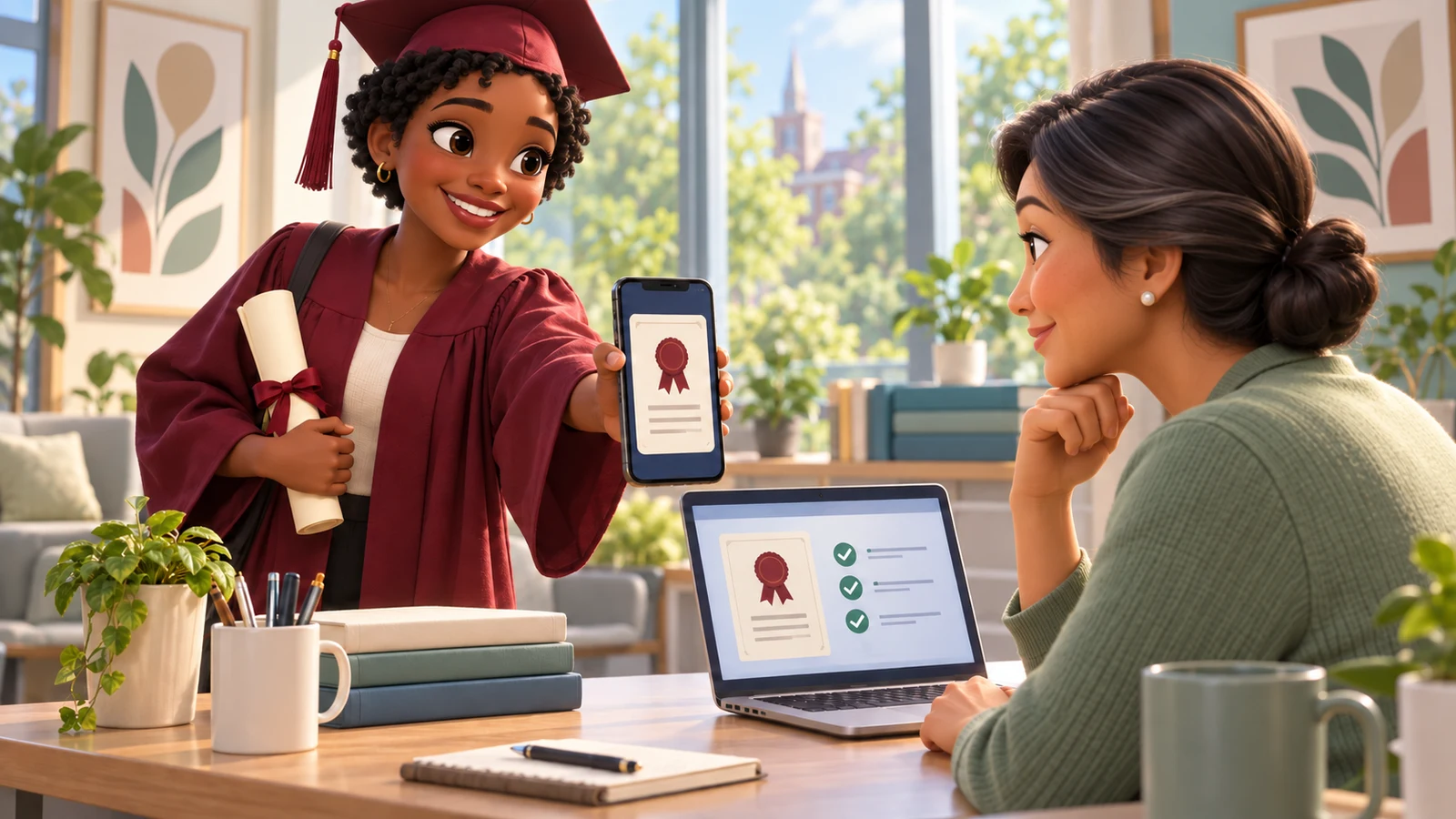
In the summer of 2017, a cohort of 111 MIT graduates had a new option alongside their paper diplomas: a digital version accessible through Blockcerts Wallet. The Registrar’s Office worked with Learning Machine on the pilot. MIT’s October 17 account named two participating groups, finance and media arts and sciences graduates. The object was familiar—a university credential—but its route to the next reader was changing.[1]
MIT Media Lab and Learning Machine had developed the open-source Blockcerts toolkit during 2016. In the diploma flow, a student’s app generated keys, MIT included the public key in the record, and the institution emailed a JSON file. A graduate could share a file or link, and a recipient could verify it through a portal without asking the Registrar’s Office to confirm each presentation. The diploma’s contents were not put on Bitcoin.[1]
A small proof links to a larger record
The Blockcerts issuer software explains how many certificates can share one blockchain anchor. It hashes the certificates and combines those hashes into a Merkle tree. The root summarizes the batch; each recipient’s certificate includes a proof of its path to that root. A verifier can recompute the relationships instead of requiring the whole batch of students’ records.[2]
This arrangement separates possession of the document from publication of the evidence. The graduate needs the actual certificate file; the chain’s compact commitment is not a backup from which a diploma can be downloaded. Comparing hashes and checking the path can establish that the presented contents match the committed record. It does not make the blockchain an examiner that knows which classes a student passed.[2]
The institution still matters
The project’s documented verification procedure goes beyond matching a hash. It checks the issuing key against the issuer’s published information and whether that key was valid when the record was issued. It also checks revocation and, if the certificate has an expiry date, expiration. Recognizing the institution behind that issuer information remains a separate trust question. An unchanged document from an unknown issuer is not automatically an MIT degree.[3]
MIT’s Registrar still describes a practical responsibility for the recipient: keep the emailed diploma file with important data and secure the wallet’s recovery passphrase. Its instructions say a lost passphrase can require a new wallet setup and contacting MIT for reissuance. That is a useful limit on the idea of independence. A graduate can carry and present the record, while the university remains responsible for issuing it. The innovation was a more portable way to verify an institutional claim, not a degree detached from its institution.[4]
Connected Stories in this Universe
Explore the chain reaction of historical breakthroughs, blunders, and legends.

OpenTimestamps: Proof a File Was Already There
A tiny proof can establish that a file existed in the past. It cannot tell you whether the file was telling the truth.
Read story →
BIP39: The Words That Can Rebuild a Wallet
Why can a few ordinary words outlive a wallet device—and when do those words lead somewhere else?
Read story →Sources & References
- [1]Source 1: MIT News, October 17, 2017: pilot and issuance flowMIT News · 2017-10-17Accessed 2026-09-24
- [2]Source 2: Blockcerts issuer: batches, Merkle proofs and certificate hashingBlockcertsAccessed 2026-09-24
- [3]Source 3: Blockcerts verification procedure: issuing keys, revocation and expirationBlockcertsAccessed 2026-09-24
- [4]Source 4: MIT Registrar: receiving, storing and recovering a digital diplomaMIT RegistrarAccessed 2026-09-24