Nouns: The Picture Is for Everyone. The Vote Belongs to the Token.
Nouns tied recurring NFT auctions to a shared treasury while opening its artwork to everyone. Its early design separated the right to reuse a picture from the power to decide how money was spent.
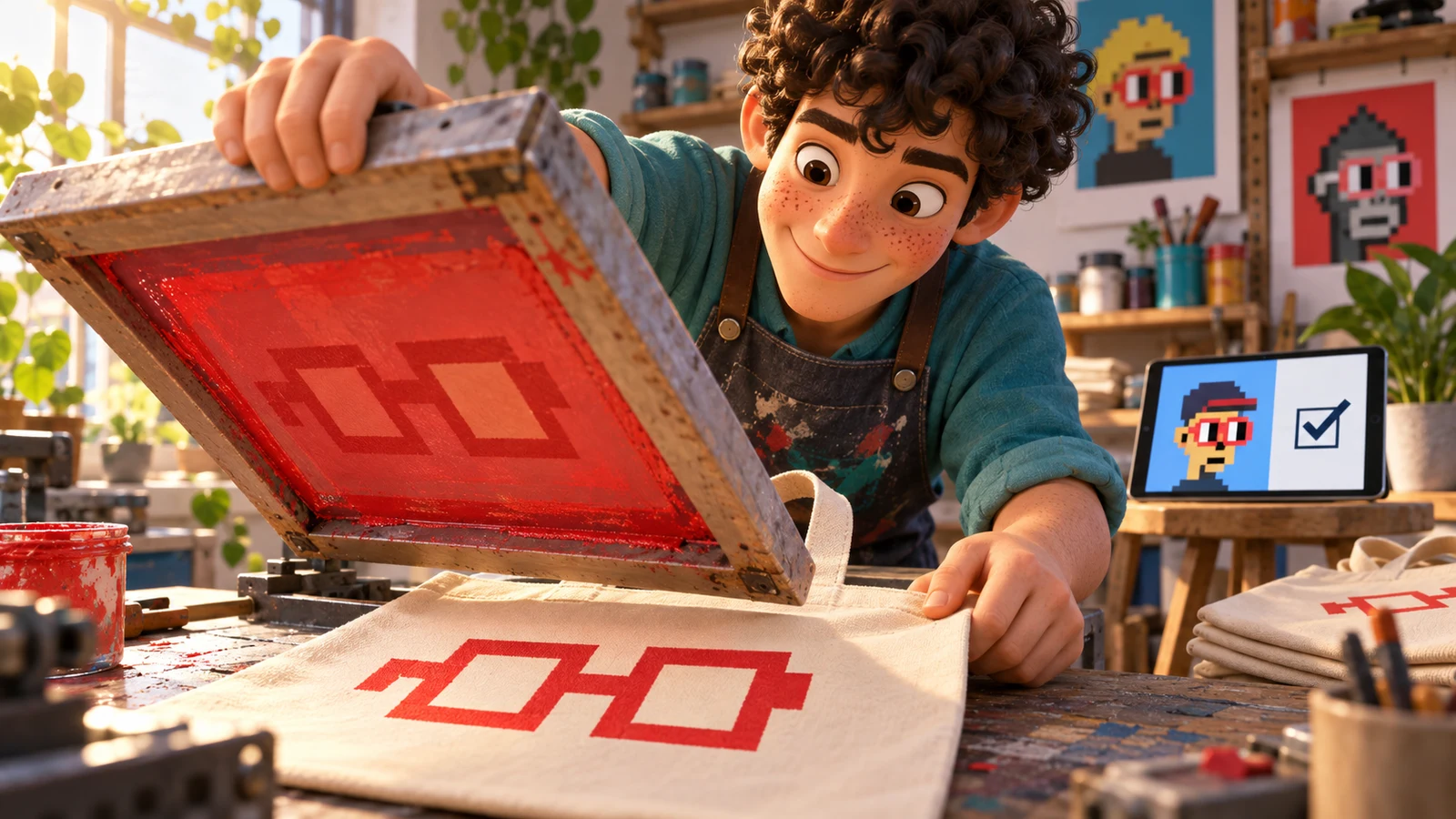
3-Minute Fast Briefing
- The ParadoxNouns paired a recurring 24-hour auction with a treasury governed by NFT holders.
- The Turning PointThe artwork was released into the public domain; copying a picture did not copy its token’s voting power.
- The LegacySettlement transactions, founder rewards and governance rules made the system more specific than the slogan of one Noun a day.
Chronological Timeline
A contemporary August 10 essay records the first auction sale on August 8 and describes the treasury-and-vote design.
In the original auction contract, a transaction settles the completed auction and creates the next one when the system is not paused.
A pair of glasses, two kinds of participation
You can put Nouns’ square glasses on a drawing without buying the corresponding NFT. You can also buy an NFT that gives its holder a voice over a shared treasury. Those are different invitations. The project’s own explanation places its artwork in the public domain while assigning one governance vote to each Noun. Its distinctive experiment was to let an image travel freely while keeping a specific decision-making role attached to a token.[4]
Nouns emerged during the NFT boom of 2021. A Remilia essay published on August 10 records an initial auction sale on August 8 and describes a collection arriving one character at a time, rather than in one large drop. The winning bid went toward a community treasury. The interesting question was already larger than who would use the next avatar: what would the people holding these tokens choose to build together?[1]
The day ends with a transaction
The early design offered a new Noun through a 24-hour auction. After the bidding period, settlement transferred the token to the winner and the auction proceeds to the treasury; the next auction could then begin. Nouns Center’s introduction makes the often-missed step explicit: the countdown ending was not itself the settlement. Someone had to send the transaction. Anyone could trigger that step under the contract’s conditions.[2][3]
Nor was this an unchangeable wall clock. The original auction code extended bidding when a bid arrived inside its closing buffer. It also allowed the owner to pause new auctions, and burned a Noun if its auction attracted no bid. The daily rhythm was a mechanism with conditions, not a promise that a buyer and a new sale would appear at exactly the same time forever.[6]
There was another exception to the everyday slogan. The token contract assigned every tenth Noun, starting with ID 0 and through ID 1820, to the founders’ organization: up to 183 founder rewards. These were tokens rather than a deduction from each winning bid. The distinction matters when reading that all auction proceeds went to the treasury; that statement did not mean the founders received no allocation.[5]
A public image and a bounded vote
The visual material was also unusually self-contained. The contract documentation explains how stored, compressed parts are assembled into SVG images and included in the token’s data. This concerns where the picture comes from. The public-domain declaration concerns how others may reuse that artwork. Neither operation creates another vote simply because someone saves or redraws the image.[3][4]
The treasury added a collective task to ownership. Holders could use governance to direct funds through proposals, rather than each buyer privately controlling the proceeds of their own auction. One Noun meant one vote, not one human meant one vote; holding several tokens could therefore carry several votes. The open circulation of the art and the distribution of decision-making power followed different rules. Early governance also included a founder veto, so token voting was not an absence of safeguards or special powers.[2][4][1]
This is the useful tension in Nouns’ original design. Someone making a poster could participate in its visual culture without becoming a voter. Someone winning an auction acquired a token and helped fund decisions they would share with other holders. A freely reusable picture could bring people together, but the picture alone could not decide how their treasury should be spent.[2][4]
Connected Stories in this Universe
Explore the chain reaction of historical breakthroughs, blunders, and legends.
CryptoPunks: The Owner Was On-Chain. Where Was the Image?
A copied portrait did not change its owner. But recording ownership was only part of keeping CryptoPunks on Ethereum.
Read story →
Decred Politeia: After the Vote, Who Sends the Money?
A community could approve a budget while someone else still held the payment keys. Decred made that gap explicit.
Read story →Sources & References
- [1]Source 1: Contemporary account of the first auction and early designRemilia Corporation · 2021-08-10Accessed 2026-09-21
- [2]Source 2: Nouns Center: auctions, settlement and votingNouns CenterAccessed 2026-09-21
- [3]Source 3: Official contract documentation: rendering, auction and treasuryNouns DAOAccessed 2026-09-21
- [4]Source 4: Official website explanation, preserved in its source codeNouns DAOAccessed 2026-09-21
- [5]Source 5: NounsToken: the founder reward minting ruleNouns DAOAccessed 2026-09-21
- [6]Source 6: Original NounsAuctionHouse: settlement, extensions and pauseNouns DAOAccessed 2026-09-21