CryptoPunks: The Owner Was On-Chain. Where Was the Image?
CryptoPunks recorded ownership of 10,000 pixel characters in 2017, before ERC-721. Storing the pictures themselves was a different task, completed in 2021. Their history separates an NFT’s owner, identifier and image.
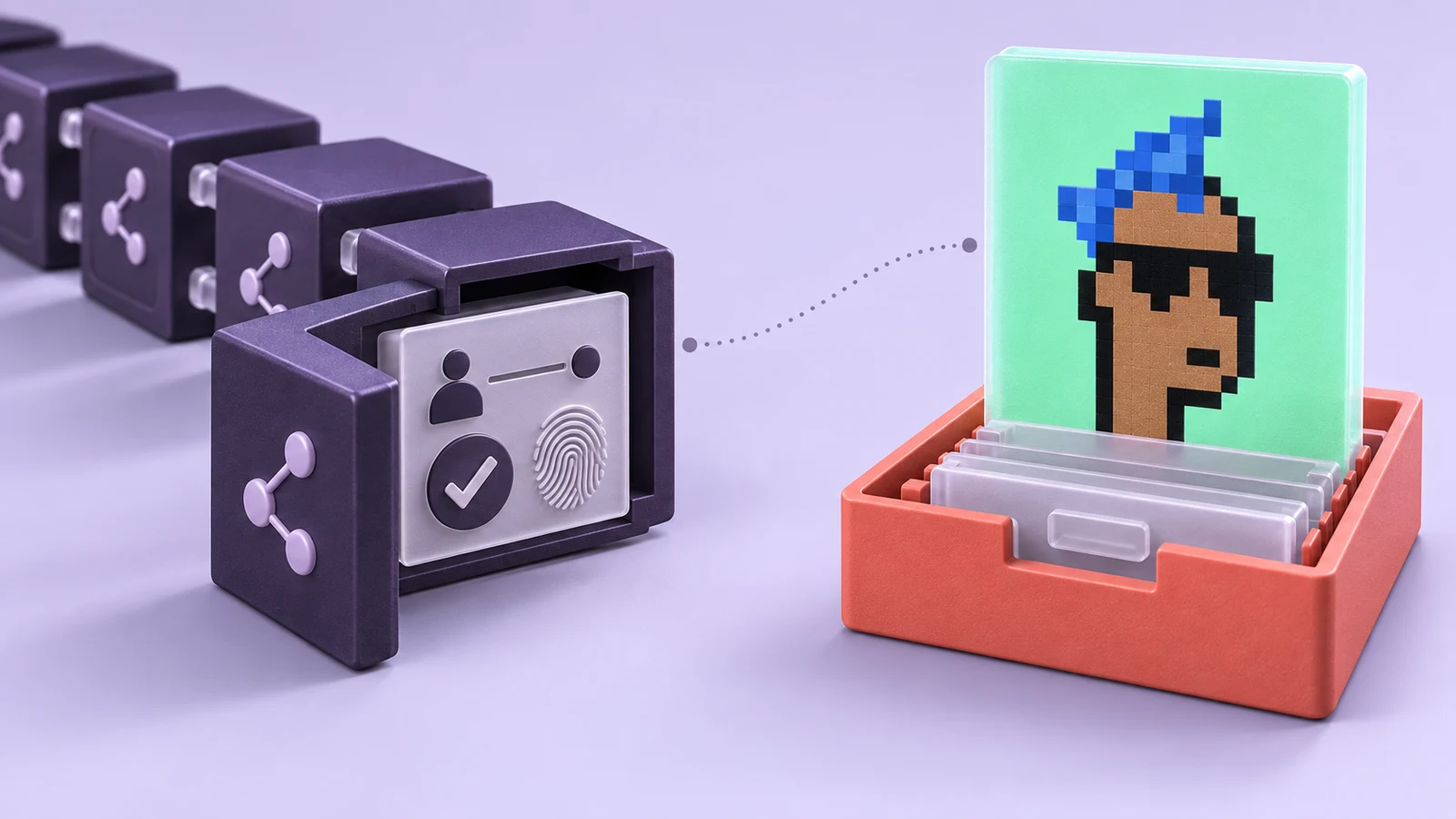
3-Minute Fast Briefing
- The ParadoxCryptoPunks launched in June 2017 with 10,000 distinct 24×24-pixel characters and its own Ethereum marketplace, before the ERC-721 standard.
- The Turning PointThe original contract recorded ownership and a hash of the composite image. A hash could verify a file; it did not contain the pixels needed to reconstruct it.
- The LegacyOn August 18, 2021, Larva Labs announced that images and attributes were available from an additional on-chain contract. That preserved image data without turning the original market into ERC-721.
Chronological Timeline
Larva Labs launches CryptoPunks, linking distinct pixel characters to ownership records on Ethereum.
The ERC-721 specification’s creation date follows CryptoPunks; it describes a common interface for tracking and transferring distinct assets.
Larva Labs announces on-chain image and attribute data that can be queried as pixels or SVG.
A Portrait You Could Copy
A CryptoPunk could fit into a square of just 24 by 24 pixels. Copying its picture was easy. When Larva Labs launched the collection in June 2017, the harder question was how to make one of those pictures belong to a particular Ethereum address in a way that other people could check. The experiment began with 10,000 distinct characters and a market written for them.[1][2]
Public claims originally carried no purchase price from Larva Labs; interacting with Ethereum still involved network fees. The important object was neither a downloaded file nor a conventional account on an art website. It was an entry in a contract, associating a particular Punk with an address. Saving the same portrait to another computer did not rewrite that entry.[2][5]
The Number Behind the Face
The contract makes that distinction unusually tangible. Its punkIndexToAddress mapping connects a Punk’s number to its owner. balanceOf counts how many an address holds. Knowing that someone owns three Punks is therefore different from knowing which three: individual identity matters even when the collection also has a balance counter.[2]
Trading was built into the same system. Owners could offer a particular Punk for sale, buyers could submit bids, and a completed purchase changed the address associated with that number. A website made these operations easier to use, but the contract supplied the ownership and trading rules. An attractive gallery page was the interface to the record, not the record itself.[2][5]
An NFT Before the Common Interface
CryptoPunks did not launch as an ERC-721 collection. Its archived FAQ explicitly describes a custom contract with some ERC-20-like balance methods. The ERC-721 specification, whose creation date is January 24, 2018, later lists CryptoPunks among the existing implementations that illustrated the problem: unique assets needed individually tracked ownership and a common way for software to handle them.[3][5]
That common interface lets a wallet or marketplace ask comparable questions about different collections. ERC-721 pairs a contract address with a token identifier and defines operations for ownership and transfers. This is a compatibility achievement, not a retroactive rewrite of every earlier project. CryptoPunks helped demonstrate the use case while retaining its own original market contract.[2][3]
A Fingerprint Is Not a Picture
There was another separation inside the original design. The contract stored imageHash, a cryptographic fingerprint of the composite image containing the Punks. Someone with the file could calculate its hash and compare the result with the stored value. That made it possible to check which image the contract referred to.[2][4]
But a fingerprint is not a backup. The hash did not contain the image bytes from which someone could redraw the portraits. An ownership record could remain available while a user still needed to obtain the actual picture elsewhere. This is why saying an artwork is on a blockchain can conceal two different questions: where its ownership is recorded, and where its visible content is stored.[2][4]
On August 18, 2021, Larva Labs addressed the second question by announcing an additional contract containing image and attribute data. It could return a Punk’s pixels or SVG, as well as traits such as hair and glasses. The team credited community members snowfro and 0xdeafbeef with pushing the work forward, including a proof of concept by 0xdeafbeef. It reported deployment costing more than 73 million gas—a measure of computation, not a dollar price.[4]
What Was Actually Preserved
Reading those image functions directly through an Ethereum client did not require submitting a paid transaction, according to the announcement. The expensive work was putting the data into the chain in the first place. This addition made the pictures retrievable from Ethereum alongside the collection’s ownership history; it did not replace the original market with a new token standard.[2][4]
ERC-721 itself does not require every image to live on-chain. Its optional metadata interface can point to a URI, and the specification explicitly allows that reference to change. A collection can therefore follow the same ownership standard as another while making very different choices about image storage. Compatibility and preservation solve different problems.[3]
CryptoPunks makes that difference visible. In 2017, a copied portrait did not give its copier the contract’s ownership entry. In 2021, storing the image data reduced reliance on finding a separate copy of the picture. The collection’s history is a sequence of practical decisions about what collectors can verify and retrieve, rather than a single switch that makes every part of digital art permanent.[1][2][4]
Connected Stories in this Universe
Explore the chain reaction of historical breakthroughs, blunders, and legends.
The $170,000 Digital Cats That Broke Ethereum: The 2017 CryptoKitties Mania
Breeding digital cats, $170K Dragon purchases, and a 25% traffic spike that paralyzed global Ethereum transactions — the legendary CryptoKitties crisis.
Read story →
Nick Szabo: The Architect of Smart Contracts, Bit Gold, and the Enduring Satoshi Enigma
From coining Smart Contracts in 1994 to designing Bit Gold in 1998, how Nick Szabo engineered the conceptual blueprint of Bitcoin and Ethereum.
Read story →Sources & References
- [1]Source 1: Larva Labs: CryptoPunks project historyLarva LabsAccessed 2026-09-13
- [2]Source 2: CryptoPunksMarket contract sourceLarva LabsAccessed 2026-09-13
- [3]Source 3: ERC-721: Non-Fungible Token StandardEthereum Improvement Proposals · 2018-01-24Accessed 2026-09-13
- [4]Source 4: On-chain CryptopunksLarva Labs · 2021-08-18Accessed 2026-09-13
- [5]Source 5: Archived CryptoPunks market and FAQLarva LabsAccessed 2026-09-13