The $100K Canvas Cipher: How a Paris Painting Hid a Bitcoin Key for Three Years (1FLAMEN6)
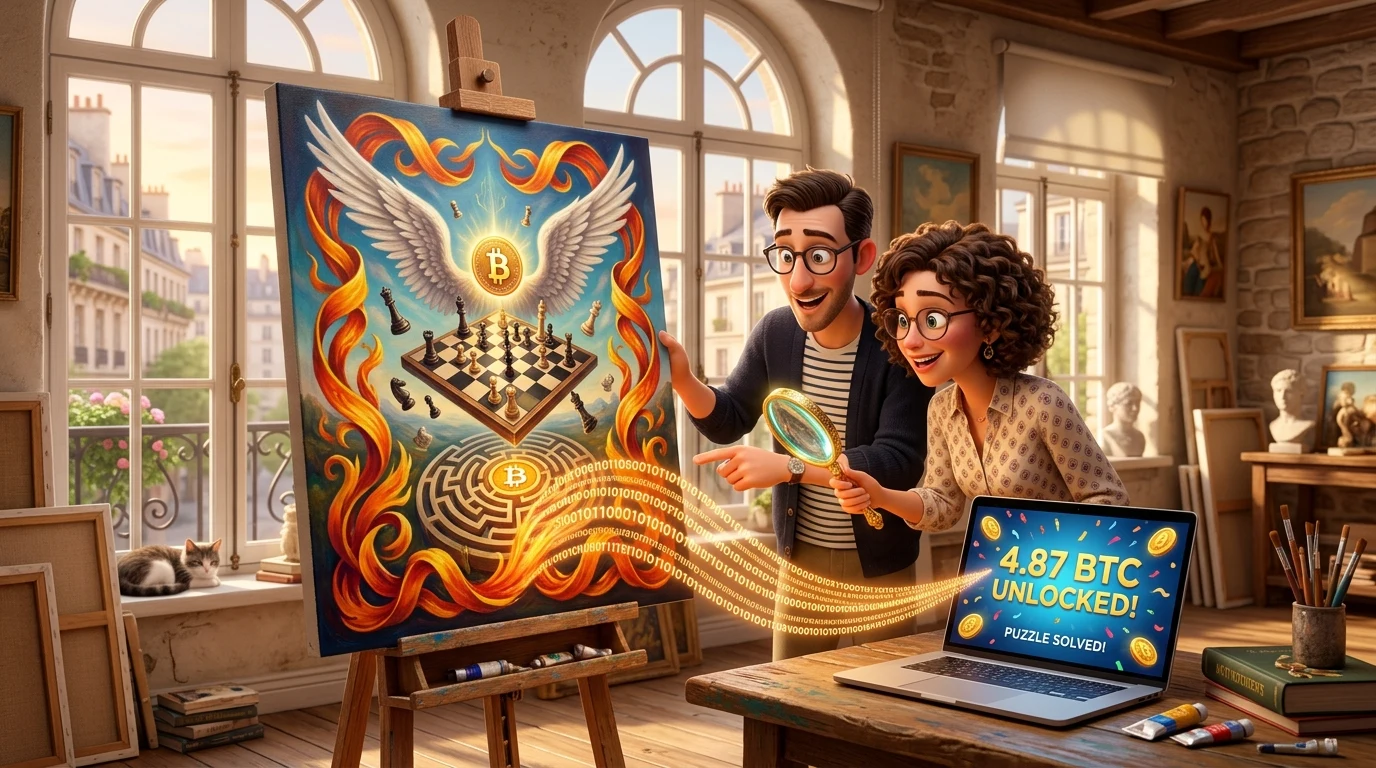
In early 2015, French artist Marguerite deCourcelle (known as coin_artist) and cryptographer Rob Myers painted a stunning surrealist canvas titled 'TORCHED H3X'. Concealed within the oil paint strokes, chess ribbons, and fiery flames was the encrypted private key to a wallet containing 4.87 Bitcoins. For three long years, thousands of mathematicians, codebreakers, and treasure hunters across the globe failed to crack it—until a 30-year-old programmer and his wife solved crypto's ultimate Da Vinci Code in a single weekend.
Key Points
- In 2015, artist Marguerite deCourcelle painted 'TORCHED H3X', embedding a 4.87 BTC private key inside intricate visual ciphers, flames, and chessboard ribbons.
- The puzzle stumped global cryptographers, Reddit sleuths, and computer scientists for 1,079 days as the underlying Bitcoin stash surged from $1,000 to over $50,000.
- In February 2018, an anonymous 30-year-old developer solved the puzzle by converting the flame border ribbons into a string of 6-bit binary sequences and claimed the prize.
Chronological Timeline
Marguerite deCourcelle releases 'TORCHED H3X' with 4.87 BTC tied to address '1FLAMEN6...'.
Global forums dissect every brushstroke, chess piece position, and pigment code without success.
The uncollected bounty's value surges past $80,000, reigniting worldwide treasure-hunting mania.
A French programmer named 'Isaac' realizes the ribbon ribbons represent binary strings.
The private key is reconstructed, draining the 4.87 BTC wallet after nearly 3 years.
1. The 2015 Paris Canvas with a $1,000 Bounty
In April 2015, in an art studio in Paris, a pioneer of the early crypto art movement named Marguerite deCourcelle (known online as coin_artist) collaborated with coder Rob Myers to complete a large surrealist oil painting titled 'TORCHED H3X' [1].
The artwork featured a woman with feathered angel wings, a floating chess board, chalices, and delicate fiery ribbons bordering the canvas. Along with the painting, deCourcelle announced an open global challenge: the private key to a Bitcoin wallet containing 4.87 BTC was encoded directly inside the brushstrokes [1].
The solution is completely contained within the artwork. Anyone with a high-resolution image and a keen eye can decode the private key.[3][2]— Marguerite deCourcelle (coin_artist, April 2015)
2. 1,079 Days of Global Codebreaking Frustration
For three years, the address beginning with 1FLAMEN6... sat untouched on the public blockchain [2].
On Reddit, Discord, and cryptography forums, thousands of codebreakers formed collaborative investigation guilds. They analyzed the chess game depicted on the canvas, measured the RGB color values of the woman's dress, and tested optical character recognition on every shadow—yet every single attempted private key failed [2].
Meanwhile, the prize grew astronomically. When the puzzle launched in 2015, 4.87 BTC was worth roughly $1,000. By late 2017, as Bitcoin neared $20,000, the treasure chest sitting inside the painting was suddenly worth nearly $100,000 [3].
3. The Weekend Breakthrough: The Ribbons of Fire
In late January 2018, a 30-year-old French programmer and blockchain enthusiast who went by the pseudonym 'Isaac' read an article about the unsolved painting while sitting in his living room [3].
Unlike previous cryptanalysts who focused on complex chess game theory, Isaac zoomed into the intricate ribbons of fire and flame-like tassels hanging along the borders. He noticed that the ribbons were divided into distinct short and long segments, decorated with subtle color shifts [3].
Working with his wife over a single weekend, Isaac mapped the ribbons: each segment represented a 6-bit binary chunk (zeros and ones) determined by whether a ribbon thread was twisted, shaded, or flaming [4].
4. Reconstructing the 64-Character WIF Key
On the night of February 4, 2018, Isaac converted the binary matrix into a 256-bit hexadecimal string and ran it through a Base58Check encoding algorithm [4].
The output yielded a valid 51-character private key in Wallet Import Format (WIF) beginning with the number 5. Trembling with adrenaline, Isaac imported the key into his Bitcoin Electrum wallet. The balance flashed green: 4.8734 BTC ($50,000+) [4].
He immediately broadcast a sweep transaction to transfer the funds into his cold storage wallet. Minutes later, the 3-year on-chain dormant wallet hit a zero balance, confirming to the entire world that the Paris puzzle had finally fallen [4].
5. The Legacy: The Birth of Gamified Web3 Art
When contacted by deCourcelle, Isaac declined to reveal his real-world identity, stating he only solved it for the sheer intellectual challenge and planned to use the Bitcoin to pay off his mortgage and hold for his family's future [4].
The '1FLAMEN6' painting established a new paradigm at the intersection of cryptography, visual art, and financial incentives. It proved that a physical painting could act as an immutable, trustless escrow vault—waiting patiently in public view for the one mind capable of deciphering its secret.
6. Evidence check: a 4.87 BTC prize, not a fixed dollar jackpot
The wallet held about 4.87 BTC and was solved in February 2018 [4]. Its dollar value changed throughout the three-year puzzle and differed by the exact price and timestamp used. Contemporary coverage described roughly $50,000 when solved, so a $100,000 title should not be treated as a fixed verified prize.
Accounts of the binary ribbon method and the solver's comments come from interviews after the transfer. They explain the solution, while the blockchain movement confirms that someone with the key spent the funds; it does not independently verify every biographical detail attributed to the pseudonymous solver [4].
Key Takeaways for Investors & Builders
Steganography Meets Cryptographic Determinism
Visual steganography can encode mathematical entropy into public physical art, proving private keys can hide openly without algorithmic detection.
Interactive Crypto Art with Financial Stakes
By linking provable on-chain prize wallets directly to canvas paintings, coin_artist pioneered the entire interactive crypto art movement.
The Irreversible Finality of Proof-of-Possession
Unlike traditional treasure hunts requiring third-party verification, the blockchain instantly and trustlessly validates the solver the millisecond a valid signature is broadcast.
Continue reading
Explore the topic through other cases and contexts.
Sources & References
- [1]Source 1: Wikipedia: Cryptographic Puzzle and Steganography in Digital ArtWikipedia · 2020-01-01
- [2]Source 2: Wikipedia: Bitcoin Address & Private Key CryptographyWikipedia · 2021-01-01
- [3]Source 3: Bitcoin Puzzle Worth $50,000 Solved After Nearly Three YearsBBC News · 2018-02-05
- [4]Source 4: The Solution to the Three-Year-Old $50,000 Bitcoin PuzzleVICE / Motherboard · 2018-02-03