Austria’s Crypto Stamp: A Letter on Paper, a Collectible on Screen
In 2019, Austrian Post put a usable postage stamp and access to a digital collectible in one small package. The experiment joined two collecting worlds without making a token transfer the same thing as delivering a letter.
3-Minute Fast Briefing
- The ParadoxAustrian Post launched its original Crypto stamp on June 11, 2019, with a €6.90 face value.
- The Turning PointThe physical stamp could be used for postage; the digital collectible could move between wallets.
- The LegacyRecording a collectible’s transfer was not the same as tracking a parcel’s journey.
Chronological Timeline
Austrian Post introduces its unicorn stamp and associated digital collectible.
A UPU study distinguishes Austria’s collectible use from shipment tracking.
One package, two different uses
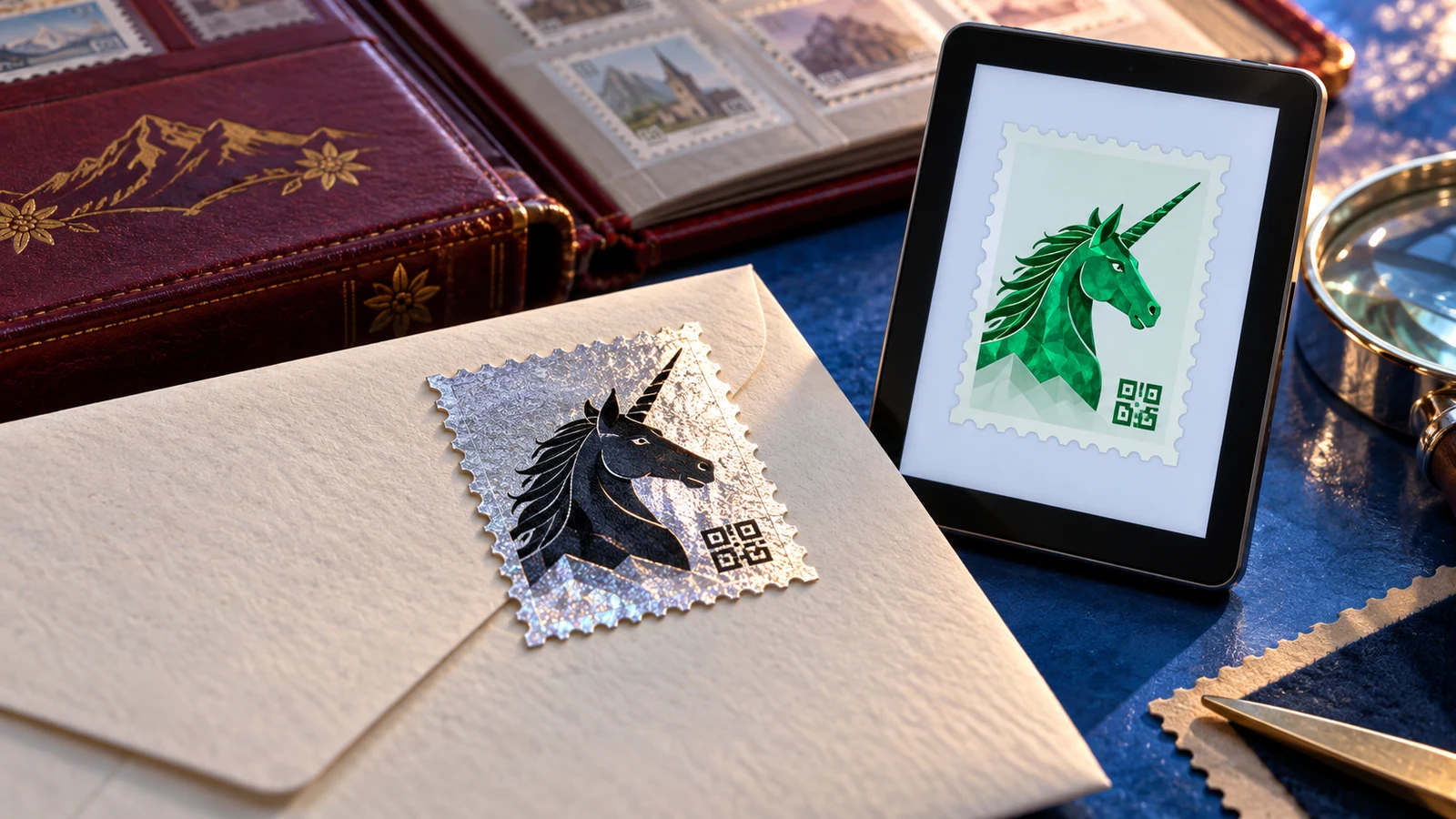
On June 11, 2019, Austrian Post introduced a stamp that invited two different kinds of use. Its original Crypto stamp came as a card-shaped block: the left part could be detached and used for postage, while the right carried concealed information for access to a digital wallet. The issue had a €6.90 face value and a print run of 150,000. Those figures described postage and issuance, not a promised resale price.[1]
Julia Obermüller designed the unicorn motif. The Museum für Kommunikation Berlin’s catalogue records the physical object as plastic with combined offset and screen printing, and identifies its digital counterpart with Ethereum. The contrast was tangible: a manufactured object for an envelope or album, alongside an asset whose wallet ownership could change without passing a stamp across a table.[1][2]
The colorful part was also a wallet asset
The museum describes five digital color variants: black, green, blue, yellow and red. This gave collectors another feature to distinguish on a screen, beyond the physical object they could handle. It helps explain the product’s appeal without turning the story into a claim about investment returns. A face value used for postage and a collector’s willingness to pay are different measures.[2]
The launch release located control of the digital stamp in wallet access information, including a secret word list hidden under scratch-off layers. It also said wallet-to-wallet transfers would be recorded on the blockchain. From that design follows an important distinction: possession of the physical collectible and control of the digital one are separate things to establish. This is an interpretation of the two-part structure, not a claim that every later sale separated them.[1]
The blockchain did not carry the envelope
The Universal Postal Union’s 2022 study drew a useful boundary. In its discussion of crypto stamps, it described Austria’s physical stamps as usable for sending packages, but noted no explicit use for tracking a package’s movement. A record of the digital collectible changing wallets should therefore not be read as evidence that a letter reached a sorting centre or its recipient. The study explored broader postal applications; it did not make all of them achievements of the 2019 issue.[3]
That leaves a smaller, more concrete story than “the post moved onto a blockchain.” An existing collecting habit acquired a digital counterpart, while the ordinary postal use remained recognizable. This account concerns the original 2019 design, not every later Crypto stamp edition. Its interesting question is still the same: when someone says they own a stamp, are they referring to an object, a wallet asset, or both? The answer depends on which part actually changed hands.[1][2][3]
Connected Stories in this Universe
Explore the chain reaction of historical breakthroughs, blunders, and legends.

Unisocks: The Moment a Token Becomes a Pair of Socks
You could trade the claim or use it. To put the socks on your feet, the token had to go.
Read story →
CryptoPunks: The Owner Was On-Chain. Where Was the Image?
A copied portrait did not change its owner. But recording ownership was only part of keeping CryptoPunks on Ethereum.
Read story →Sources & References
- [1]Source 1: Austrian Post’s June 11, 2019 launch releaseÖsterreichische Post AG / APA-OTS · 2019-06-11Accessed 2026-09-23
- [2]Source 2: Museum catalogue, item 21: materials and digital color variantsMuseum für Kommunikation BerlinAccessed 2026-09-23
- [3]Source 3: UPU, 2022, printed page 26: collecting versus shipment trackingUniversal Postal UnionAccessed 2026-09-23