Blockstream Satellite: The Ledger Arrives from the Sky
In 2017, Blockstream began broadcasting Bitcoin data by satellite. Full-history synchronization followed in 2020. The receiver reveals a useful distinction: getting the ledger and sending a payment require different communication paths.

3-Minute Fast Briefing
- The ParadoxBlockstream launched its satellite broadcast on August 15, 2017; ground stations sent Bitcoin data to communication satellites.
- The Turning PointSatellite 2.0 added synchronization from the genesis block in May 2020. Version 1.0 still required internet access for the initial sync.
- The LegacyThe receiver is a one-way link. A payment still needs an outward route to the Bitcoin network, and the broadcast needs working physical infrastructure.
Chronological Timeline
Blockstream announces satellite delivery of Bitcoin blockchain data.
Satellite 2.0 adds synchronization all the way from the genesis block.
The Base Station announcement describes an antenna with a built-in receiver and a one-way data connection.
A Dish, a Computer, a Copy of the Ledger
On August 15, 2017, Blockstream announced a service that sent Bitcoin blockchain data through communication satellites. Its launch release described ground stations, called teleports, uploading the data and satellites broadcasting it over wide areas. The interesting destination was an ordinary computer on Earth: a node could receive the record through a different physical route.[1]
That made the project different from putting a signing device in orbit. No private key had to travel into space to approve a payment. The service transported the public record. For someone whose ordinary connection was expensive or unreliable, an antenna offered another way to keep that record arriving. Coverage, receiver equipment and a working installation were still necessary.[1][4]
The Missing Beginning
There was a catch in the first version. Keeping up with new blocks and obtaining the entire past are different jobs. Blockstream’s later account says version 1.0 required an internet connection for the initial synchronization. A description that gives the 2017 system every capability of its successor erases a real engineering step.[2]
On May 4, 2020, Satellite 2.0 added full-history synchronization from Bitcoin’s genesis block. It used DVB-S2, a satellite broadcasting standard, alongside changes to bandwidth, compression and error correction. Separate streams carried historical data and recent activity. A new receiver could now acquire the chain’s past through the satellite feed while the network continued producing blocks.[2]
Receiving Is Not Sending
The project’s software guide describes Bitcoin Satellite, a version derived from Bitcoin Core through FIBRE that can receive blocks in satellite-delivered data packets. It also documents a mode with internet peer connections disabled. The receiving computer still runs node software; an antenna does not replace the work of processing the blockchain.[3]
But the dish is not a two-way Bitcoin telephone. Blockstream explicitly describes the receiver connection as one-way. Consider a user who signs a new payment locally: receiving other people’s blocks does not carry that signed transaction out to miners. It needs a separate outward communication route. This follows from the direction of the link, rather than from any defect in the signature.[4]
What the Message API Adds
The Satellite API can look like an exception because it lets users send messages for satellite broadcast. Its documented route resolves the puzzle: a sender application submits a file or message to an API server; a Lightning payment pays for the order; the server forwards the message to a ground station for broadcast. The receiver dish has not become an uplink.[5]
Nor does paying for that broadcast, by itself, put a Bitcoin transaction into a block. The API delivers message data. Bitcoin transaction propagation and inclusion remain separate questions. A paid message channel and a free blockchain feed may share satellite infrastructure without being the same service.[1][5]
An Extra Route Still Has Dependencies
The appeal is practical: one failed internet route need not cut off every source of blockchain data. Yet a one-way feed cannot repair a power failure, remove an obstruction in front of a dish or keep a stopped broadcaster running. The antenna, reception conditions, ground stations and local computer remain part of the system. This is an additional route with its own dependencies.[1][4]
The 2017 launch and the 2020 upgrade make that achievement clearer when read together. Bitcoin’s ledger could reach a user through television-style broadcast infrastructure, and later its whole history could take that route. The enduring question is therefore directional: which information can reach this node, and how will the next transaction leave it?[1][2][4]
Connected Stories in this Universe
Explore the chain reaction of historical breakthroughs, blunders, and legends.
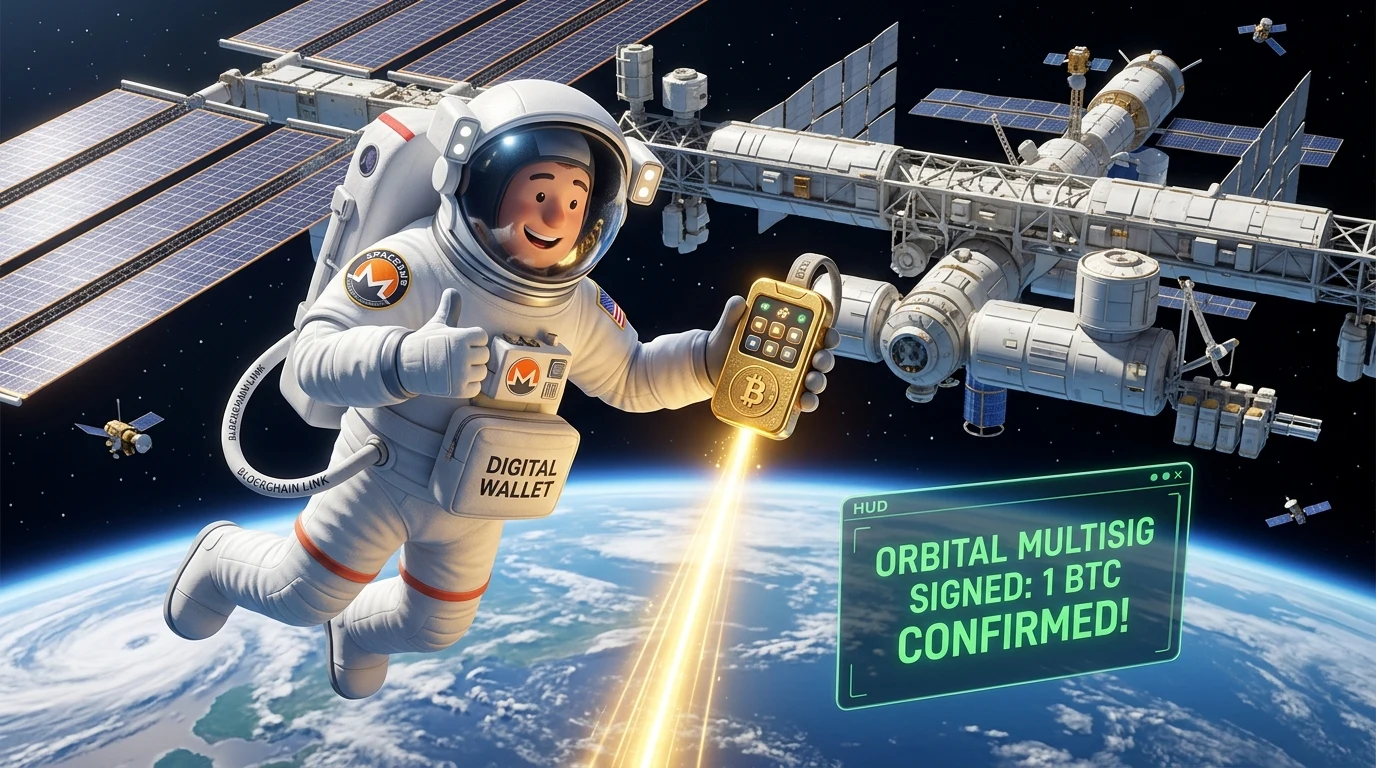
The Bitcoin Transaction That Needed One Signature from Orbit
A Qtum payload came first. The ISS experiment later added one orbital signature to a Bitcoin transaction—and proved less, and more, than the mythology suggests.
Read story →
The Lightning Torch: A Payment Could Arrive. Would It Leave Again?
Add 10,000 satoshis and pass it on. A small relay tested both Lightning payments and the people receiving them.
Read story →Sources & References
- [1]Source 1: 2017 launch: ground stations and satellite broadcastBlockstream · 2017-08-15Accessed 2026-09-15
- [2]Source 2: Satellite 2.0: full-history synchronizationBlockstream · 2020-05-04Accessed 2026-09-15
- [3]Source 3: Bitcoin Satellite: receiver software and node configurationBlockstreamAccessed 2026-09-15
- [4]Source 4: Base Station: a one-way connectionBlockstream · 2021-04-28Accessed 2026-09-15
- [5]Source 5: Satellite API: submission, payment and ground-station broadcastBlockstreamAccessed 2026-09-15