The Death Spiral: How Anchor's 20% Mirage and Algorithmic Arbitrage Torched Terra-LUNA
TerraUSD’s dollar peg relied on exchanges with LUNA, while Anchor’s subsidized yield drew a concentrated deposit base. In May 2022, withdrawals, falling prices and new issuance fed a destructive loop. Follow the mechanism, the chain halts and the separate 2024 civil fraud findings.
Key Points
- UST targeted an exchange of 1 UST for $1 worth of LUNA. Fees, trade-size-dependent spreads and chain operation affected actual conversion; it was not a guaranteed cash withdrawal.
- Anchor’s subsidized yield hovered around 19.5% before a May 2022 rate change. Studies place roughly three quarters of UST in the application before the collapse.
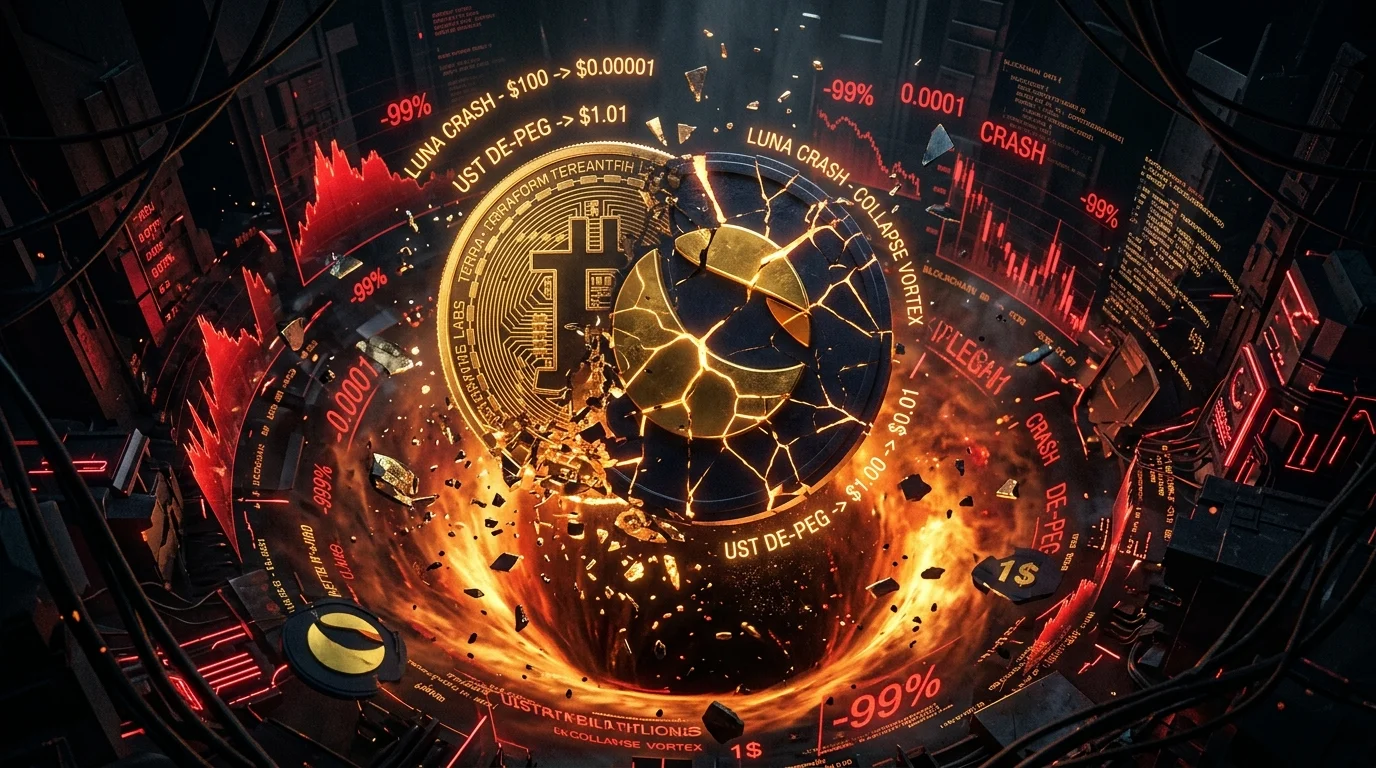
- May 2022 redemptions and falling LUNA prices fed a death spiral. A daily research table records about 6.53 trillion LUNA at the start of May 14; the SEC later described $40 billion in lost market value.
Chronological Timeline
Platias and Di Maggio model a dilution-price feedback risk but conclude that the peg withstands the stresses in their simulations.
Anchor grows around a yield near 19.5%; a reserve-linked rate adjustment begins on May 1, 2022.
Large Anchor withdrawals and UST sales accompany pool rebalancing; the run accelerates late on May 9.
The chain first halts on May 12, then again on May 13. The daily table records around 6.53 trillion LUNA at the start of May 14.
The April 5 jury verdict establishes civil fraud liability. The June 12 consent judgment precedes the SEC’s announcement of a settlement exceeding $4.5 billion.
1. The Dollar Without Reserves: Algorithmic Alchemy
In 2018, Do Kwon and entrepreneur Daniel Shin founded Terraform Labs. Its best-known experiment became a dollar-denominated token whose stability depended on another token rather than a bank account holding one dollar for every unit. That distinction was the foundation of TerraUSD’s promise—and of the risk its holders eventually faced.[10][3]
The mechanism paired TerraUSD (UST) with LUNA. Its target conversion was 1 UST for $1 worth of LUNA, using the protocol’s price feed. In a simplified example before fees, a trader could burn $1 of LUNA to mint 1 UST and sell it at $1.01; at $0.99, buying and burning UST for $1 worth of LUNA offered the reverse incentive. Actual swaps faced fees and spreads that changed with trade size and the state of the module’s virtual pools. This was a stabilization design, not an unconditional dollar withdrawal guarantee.[8]
The crucial question was whether buyers would continue to value the LUNA issued to absorb UST redemptions. Creating more tokens could change the distribution of claims on the ecosystem; it could not create outside purchasing power. If sellers wanted to leave while demand for LUNA weakened, the mechanism could amplify the pressure it was intended to relieve.[7][8]
2. Anchor Protocol: The $14 Billion 20% Yield Mirage
Terraform Labs launched Anchor Protocol in March 2021. The lending and savings application offered a heavily subsidized deposit yield that hovered around 19.5%, making UST attractive to people seeking returns as well as payments. That historical rate was not a permanent contractual guarantee: a change implemented on May 1, 2022 linked the deposit rate to movements in the yield reserve.[9]
By the period before the collapse, Anchor held the great majority of circulating UST. Harald Uhlig’s July 2022 study put the share at about 75%; against nearly $19 billion of UST capitalization in early May, that indicates a deposit base of roughly $14 billion. These are approximate measures of concentration, not a cash reserve protecting depositors. A yield near 20% did not make either the token’s dollar price or the investment risk-free.[10]
The economic strain was already visible before the peg broke. Research by Jiageng Liu, Igor Makarov and Antoinette Schoar found that Anchor subsidized both lending and borrowing and that the subsidy requirement had reached about $6 million a day by April 2022. A large share of UST demand depended on one application whose payout required continuing support. High deposits therefore measured both adoption and a shared point of vulnerability.[9]
3. May 2022: Curve Trading and the Bank Run
On May 7, 2022, large withdrawals from Anchor coincided with trading pressure on Curve and Binance and a planned rebalancing of Curve’s UST-3Crv pool toward a new pool. Liu, Makarov and Schoar traced the sequence from withdrawals to transfers and sales. Their evidence supports a run involving several large wallets; it does not require the story to assume a single coordinated attacker.[9]
Withdrawing liquidity and selling UST were different actions. Removing UST alone from a pool did not remove the other stablecoins available to buyers. The researchers then traced sales that widened UST’s discount, followed by trades attempting to restore the peg. The order matters: a planned pool adjustment and the market’s subsequent response were not a single transaction with a single effect.[9]
By late May 9, withdrawals intensified and UST fell to around $0.75. The researchers found that large, more sophisticated investors tended to exit earlier, while smaller and less sophisticated wallets moved later. This was a bank run through exchanges, bridges and a lending application: the ability to see transactions on a blockchain did not give every holder the same opportunity to escape.[9]
4. The Death Spiral: 6.5 Trillion LUNA and Total Meltdown
As the peg failed, burning UST for newly minted LUNA was one possible route out, alongside selling on exchanges. It was never a guaranteed cash exit. Market-module spreads affected the amount received on conversion, and even a completed swap left the holder needing a buyer for LUNA. Falling confidence in that second token was therefore part of the redemption problem itself.[8][10]
The arithmetic depends on LUNA’s oracle price, not UST’s exchange price. Ignoring fees and spreads, the target for burning 1 UST was $1 divided by LUNA’s dollar price. At $10 per LUNA that means 0.1 LUNA; at $1 it means 1 LUNA—ten times as many. UST trading at $0.10 alone does not multiply the minted amount tenfold. A falling LUNA price, combined with continuing redemptions, increased the number of tokens issued.[8]
Nicholas Platias and Marco Di Maggio’s May 2019 stability stress test discussed a feedback loop between dilution and declining LUNA prices. Their simulations nevertheless concluded that the peg was robust under the modeled stresses. The paper identified a possible failure mechanism; it did not establish that the later system was safe in every market condition.[7]
Uhlig’s reconstruction records the first chain halt on May 12 at block 7,603,700, followed by a restart and another halt on May 13. Its daily table puts LUNA supply at about 6.53 trillion at the start of May 14. The trillion-token total was not already present at the first halt. Issuance and price collapse unfolded across this sequence, while interruptions to the chain exposed the limits of any supposedly always-open conversion route.[10]
5. Classic, a New Genesis and the Civil Fraud Judgment
The collapse erased tens of billions of dollars in market value. In its June 2024 account, the SEC described approximately $40 billion being wiped out after UST and other Terraform tokens plunged toward zero. That is the agency’s market-value measure, not $40 billion in cash paid out or a verified seven-day loss total. The shock spread through crypto markets, but the later failures of individual lenders and exchanges cannot all be reduced to this one cause.[5][13]
Following the revival plan associated with Proposal 1623, the original network continued as Terra Classic, with LUNC and USTC. A separate new genesis created Terra’s phoenix-1 chain and its LUNA token; the migration guide distinguishes it from the original columbus-5 chain and omits the old market, oracle and treasury modules. The old chain was not simply erased, and the new LUNA was not merely a renamed balance on it.[11][12]
On April 5, 2024, a federal jury found Terraform Labs and Do Kwon liable for securities fraud in the SEC’s civil case. The court approved a final consent judgment on June 12, and the SEC announced a settlement of more than $4.5 billion, including disgorgement, prejudgment interest and civil penalties. Those obligations were not proof that holders had already been repaid: recovery was to proceed through Terraform’s bankruptcy process. The engineering failure and the civil findings belong in the same history, with their different meanings kept clear.[5][6]
Key Takeaways for Investors & Builders
The Structural Flaw of Unbacked Algorithmic Pegs
A target exchange ratio cannot create buyers for the token issued on redemption. When LUNA demand and price collapsed, continued issuance could deepen dilution rather than restore the peg.
Subsidized Yield Creates Toxic Concentration Risk
Concentrating UST demand in a subsidized yield application exposed holders to a shared withdrawal shock. A quoted return cannot substitute for durable revenue or market liquidity.
Token Lineage and Legal Accountability
The original network continued as Terra Classic, while new LUNA belongs to a separate genesis chain. Civil liability and ordered payments must also be distinguished from completed investor recovery.
Continue reading
Explore the topic through other cases and contexts.

Sources & References
- [1]Source 1: SEC Charges Terraform Labs and Do Kwon with FraudU.S. Securities and Exchange Commission · 2023-02-16
- [2]Source 2: Terra (blockchain): overview and historyWikimedia Foundation
- [3]Source 3: Do Kwon: biography and legal historyWikimedia Foundation
- [4]Source 4: Stablecoins: Legal Issues and Regulatory ResponsesCongressional Research Service
- [5]Source 5: Terraform and Kwon to Pay $4.5 Billion Following Fraud VerdictU.S. Securities and Exchange Commission · 2024-06-13
- [6]Source 6: Terraform civil judgment and investor recovery processU.S. Securities and Exchange Commission
- [7]Source 7: Terra Money: Stability Stress Test (May 2019)Nicholas Platias / Marco Di Maggio
- [8]Source 8: Historical market module: swaps, spreads and virtual poolsTerra Classic Documentation
- [9]Source 9: Anatomy of a Run: The Terra Luna CrashJiageng Liu / Igor Makarov / Antoinette Schoar — NBER
- [10]Source 10: A Luna-tic Stablecoin CrashHarald Uhlig — NBER
- [11]Source 11: Exchange migration guide: Classic and the new Terra chainTerra Documentation
- [12]Source 12: Phoenix-1 genesis launch procedureTerra Genesis Tools
- [13]Source 13: Financial Stability Report, November 2022: Funding RisksBoard of Governors of the Federal Reserve System